Sunday, January 30, 2011

Hiking in North Vietnam’s limestone mountains

Three days and two nights in Vietnam’s nature reserve, an experience with ethnic tribes on rice terraces amidst a limestone landscape. Our guide knows this place by heart, every turn of the ridges and hidden waterfalls and shorter trails, every native house where tourists like us will have to stay.

We set off in pairs, in puny 100cc motorbikes riding through 130 kilometers of the country’s ephemeral rural setting – the rice paddies that may one day give way to modern development, small towns bustling with artisans and vegetable markets, vast plantations of sugar cane, and the vision of what was once the heart of Indochina.

The Pu Luong conservation area is Vietnam’s answer to ecotourism. It was declared a reserve only in the past two years, effectively putting a stop to logging and keeping the enclave as alluring and authentic as possible in the eyes of foreign tourists who see Vietnam with a weight for history in this corner of Asia.

A solitary farmer works silently in the rice terraces inside the Pu Luong reserveA solitary farmer works silently in the rice terraces inside the Pu Luong reserve.

On our first day, we arrive in the small village, the southern edge of the sprawling 17,200-hectare nature park in Thanh Hoa province. Mid-afternoon, we chance upon high school students pedaling home in their bicycles, wearing their blue-and-white jacket uniform. All the girls have ponytails down the length of their backs. They smile at us. They know this park is gaining reputation among foreigners.

But it feels as though it is just us, the first to tread this piece of land, all for us as we want it. Not once did we come across other tourists. Taking a leisurely walk, we snap pictures of the bamboo water mills that feed into the irrigation, dozens of ducks on ponds, water buffaloes that are so familiar from home. We remove our sweater and windbreakers, perspiring from the hike.

Down the Ho Chi Minh highway

As it gets steeper, I start to whine. What Truong - our guide says would take only six kilometers was beginning to take a toll on an uphill slope. We reach the home-stay shelter by nightfall. There is an eclipse tonight, giving a bare silhouette of the rice terraces. We have only reached as high as 500 meters.

The homes of these ethnic tribes are similar renditions of the kalangbanwa of the Pala’wan or the longhouses of Borneo – erected on solid tree trunks, with floors of split bamboo, and thatched roofs. The owners of the house are a young, mixed couple of the White Thai and the Muong, who offer us tea as their greeting.

We sit huddled for dinner. Truong is the master chef, serving us the best of homemade cuisine of pho noodle soup, tofu with dill sauce, and papaya salad. He is in demand; even here his cell phone keeps ringing and his voice shatters the silence. We celebrate the evening with cheers over rice wine.

Our second day, as announced by Truong, is a trek of about 15 kilometers. But you can take your time in the morning, he says. In my moments of cynicism, I ask myself why I pay 40 U.S. dollars a day for a hiking trip that I could very well do back home and with rice terraces to boot, in Banaue. It may well be that, here, the limestone mountains loom over us, casting mystery.

Or was I taken in by the bamboo forests, scattering a vibrant green over the grayness of the clouds and the rocks and the empty fields? Did the red bloom of the poinsettias charm us as it appeared here and there on our trail? Were we awed by the villagers harvesting manioc, or fascinated by the elderly tribal women welcoming us with open smiles of their betel-stained teeth?

The trail back to Ninh Binh passes by a water reservoir flanked by limestone mountainsThe trail back to Ninh Binh passes by a water reservoir flanked by limestone mountains.

Just when I think the trip is done, the best part of it comes at the very end: on the way back to Ninh Binh, after Truong stops us smack in the middle of the highway to show us a part of the famous and historical Ho Chi Minh Highway that connects the north and the south of the country’s elongated mass, we take a ride through the water reservoir that the French had helped to build.

I have read somewhere that heaven and earth trade places in Vietnam – and here we are going through it, kilometer after kilometer. There is no way back to the past or the future, it is as it is despite the motion of our motorcycle. Vietnam’s transition is on hold; there is a very keen sensation that we are part of a canvas of a brush painting, a watercolor. This must be why the French had come here, the country of Marguerite Duras’s lover.

The limestones are within distance, and tourists also flock here for the Tam Coc and Cam Ang caves which are actually tunnels of waterways. After the hike in Pu Luong this becomes anti-climactic and it is best to just stroll the rice fields, seeing rare birds along the way. Most of the time there would be massive flocks of egrets, swirling around the jutted rocks like a white ribbon.

Source: gmanews.tv

Recommendation tours:
Trekking in Pu Luong Nature Reserve
Trekking Cuc Phuong National Park

Visit to Vietnam and Cambodia in uncommon vacation

If you are the type that enjoys the uncommon vacation and exploring areas of the world that most do not, I have some ideas for you in travelling to Vietnam and Cambodia.

How about flying into Bangkok, Thailand and exploring this fascinating Asian city before moving on to Angkor Wat in northern Cambodia followed by a visit to Vietnam.

Fly on to Siem Reap in Cambodia from Bangkok. Here is the mystical temple complex of Angkor. You will have the opportunity to visit the new Angkor National Museum, which showcases the Golden Age of the Khmer Era.

A guide will walk you through the temple complex which is vast and set in the outskirts of jungle. Angkor Wat and Angkor Thom are former temples with carved smiling faces and detailed bas-reliefs depicting scenes of everyday life in the 12th century.

Angkor Thom, CambodiaAngkor Thom, Cambodia

There will also be the opportunity to visit Ta Prohm, a haunting, jungle-bound temple. Angkor Thom was hidden from the outside world until the earlier part of the 20th century until French explorers found the area and put together a work force to clear the jungle overgrowth. Later other countries sent people to assist in the work. It is now open to visit for your exploration.

Angkor Wat was constructed between the 9th and 13th century. It is revered as one of the world’s most impressive temple sites.

I have had the pleasure to visit Angkor Wat and Angkor Thom twice in my lifetime and for me it is second only to the antiquities in Egypt.

On the outskirts of Angkor Wat is Angteay Srei temple, a true jewel of Khmer art. Its red sandstone walls, decorated with elaborate carvings, are amazingly preserved.

You will also have the opportunity to see Preah Khan, originally a Buddist monastery, now a temple showcasing elaborate carvings.

You can even set sail on Tonie Sap, the great lake of Angkor Wat. There are communities that live and work on the lake and you can see the population in their daily lives.

Next, I suggest your flying on to Hanoi in Vietnam. Here, you will also need to be part of an organized tour unless you choose to hire a private guide and automobile.

A guide will inform you about Vietnam’s economy, which has come up since the war. I just purchased a pair of shoes and I looked inside to see where they were made — Vietnam!

While there, step inside the Ho Chi Minh Mausoleum. At One Pillar Pagoda is seen Vietnamese history spanning a thousand years.

In Hanoi, explore the old quarter, revered as a jewel of Hanoi because of its idyllic setting around pristine Hoan Kiem Lake and the nearby labyrinthine streets dedicated to regional merchandise.

One night, book a seat at the famous Vietnam Water Puppet Theatre.

Halong Bay, VietnamHalong Bay, Vietnam

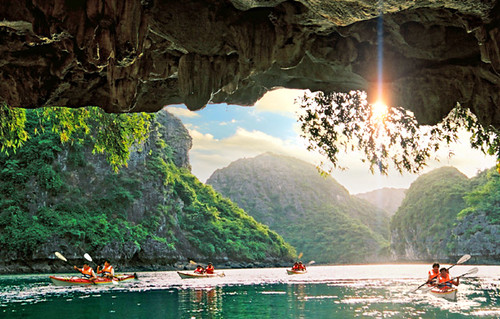
Another morning, drive to Halong Bay where you will board a junk boat for an overnight cruise. You can also take a sampan ride to discover a small gateway of the limestone karst, which opens into a scenic lagoon with coral reefs.

Another morning you can experience a Tai Chi lesson if you wish. Now, on to Danang and a short drive to the city of Hoi An, the 16th and 17th century trading port of Vietnam. How about taking a pedal cab tour of Hoi An to see and photograph the lifestyle of the local people and the Chinese architecture which is unspoiled since the 17th century.

Then you can drive along the coast from Hoi An to the city of Hue. Here is time to see the old Imperial City, including the Citadel and then Thien Mu Pagoda.

Also while in Hoi An, you can take a leisurely cruise up the Perfume River to the cooking school. You will be able to cook Vietnamese style when you get home. The school will show you how you can cook five traditional Vietnamese meals.

Now it’s time to visit the Mekong Delta and the agricultural region so well known during the war. Here, you can board a small boat to explore the small islands and perhaps stop at a fruit stand for a local snack.

How to travel there

ACTIVETRAVEL ASIA is one of leading tour operator include adventure tours and uncommon activities in Vietnam, Laos and Cambodia. Reach them at info@activetravel.asia or visit their website: http://www.activetravel.asia

Wednesday, January 26, 2011

Discover real Vietnam on travel review

The idea of Vietnam conjures strong images in the Western mind. Many come from a few iconic Vietnam War films. The country still features those lush rustic landscapes, peaceful now, of course, but modern Vietnam has grown beyond the definition of misty paddy fields and peeling houses, captivating as these certainly are.

Vietnam Travel
Sapa Field, Vietnam

Remnants of war – the Cu Chi tunnels near Saigon, for example – have been preserved for visitors to witness. However, the Vietnamese have very much put hostilities behind them, staying cheerfully focused on the future. These days, most Vietnam tours take in sights that range from pristine French architecture in Hanoi to jungle riverways in the Mekong Delta.

So, when you visit Vietnam, how can you encounter its complete personality? A good start is by leaving your preconceptions at home. Arrive in any country with a fixed idea of what it’s about and you risk overlooking things that don’t fit into your theory. Land in Vietnam with a clear head and you’ll begin to perceive the superb layers of culture that tint, obscure and highlight each other throughout this remarkable country.

Just over 1,000 years ago, long before the French colonised Vietnam, the Vietnamese secured independence from China and flourished, for hundreds of years, under their own dynasties. The emperors considered themselves divine, creating huge ornate palaces, and tombs designed for comfort in the afterlife. Many of these were destroyed by subsequent warfare and colonial development.

Luckily, Hue, on the coast, where the border between North & South once divided the country, has been preserved. Its fortified citadel is enormous: four square miles of forbidden city, once home to emperors and their concubines and inaccessible – on pain of death – to anyone else. This is one of the few places in the country where this era of dynastic Vietnam is still visible.

In 1885 the whole of Vietnam became part of the French Indochina colony. Both Hanoi and Saigon (now officially known as Ho Chi Minh City) are full of astonishing French architecture, from a post office designed by M. Eiffel in Saigon to the ornate Presidential Palace and French Quarter in Hanoi. When the Vietnamese leaders finally re-secured their country’s independence in the 1970s, they began using the old French government buildings as their own. The power symbolized by these imposing foreign structures suddenly belonged to the nation.

Hanoi is also home to the tomb of “Uncle” Ho Chi Minh himself, whose embalmed body is revered and on display for visitors to see. Expect to queue, here, but this somewhat macabre exhibition really transmits the magnitude of relief and gratitude the Vietnamese must have felt when Uncle Ho finally negotiated independence after centuries of occupation and war.

And yet, behind the triumphant modern bustle, along mountain passes and misty valleys, lies another remarkable achievement. Despite all the turmoil, a number of indigenous tribes still lead traditional lives, coming into villages to trade and greet visitors. They’re very friendly – you may be surprised by how well they speak English -and their existing at all demonstrates Vietnam’s determined pride in survival.

Sunday, January 23, 2011

When to travel Sapa, Vietnam

Travelers to Sapa in summer can feel the climate of four seasons in one day. In the morning and afternoon, it is cool like the weather of spring and autumn. At noon, it is as sunny and cloudless as the weather of summer. And it is cold in the evening.

With no advance warning of a thunderstorm short and heavy rains may come at noon on any summer day. Subsequently, a rainbow appears, transforming Sapa into a magic land, which for years has been a constant source of poetic inspiration, lights up the whole region.

The terraced fields in Sa Pa, VietnamThe terraced fields in Sa Pa, Vietnam

The best time to witness the scenic beauty of Sapa is in April and May. Before that period, the weather might be cold and foggy; after that period is the rainy season. In April and May, Sapa is blooming with flowers and green pastures. The clouds that settle in the valley in early morning quickly disappear into thin air.

Sapa has many natural sites such as Ham Rong Mountain, Silver Waterfall, Rattan Bridge, Bamboo Forest and Ta Phin Cave. Sapa is also the starting point for many climbers and scientists who want to reach the top of Fansipan Mountain, the highest mountain in Vietnam at 3,143m. Hoang Lien Mountain Range is also called the Alps of the North Sea area since Fansipan Mountain is not only the highest peak in Vietnam, but also in the Indochina Peninsula. The pyramid-shaped mountain is covered with clouds all year round and temperatures often drop below zero, especially at high elevations.

The first thing you notice when approaching the resort town are some detached wooden mansions and villas perched on a hill top or hillside, behind thick pine forests and almost invisible on this foggy morning. Old and new villas with red roofs now appear and now disappear in the green rows of pomu trees, bringing the town the beauty of European towns.

Fresh and cool air in Sapa is an idea climate condition for growing temperate vegetables such as cabbage, chayote, precious medicinal herbs, and fruit trees such as plum, pear…

Sapa is home to various families of flowers of captivating colours, which can be found nowhere else in the country. When Tet, the Lunar New Year Festival, comes, the whole township of Sapa is filled with the pink colour of peach blossom brought from the vast forests of peach just outside the town. Sapa is regarded as the kingdom of orchids. Here, orchid lovers are even amazed by the choice, when trekking in the forest filled with several hundred kinds of orchids of brilliant colours and fantastic shapes, such as Orchid Princess, Orchid of My Fair Lady’s Shoe. Some orchids are named after lovely singing birds such as the canary, salangane’s nest, and more.

Cherries blossom in Sapa, VietnamCherries blossom in Sapa, Vietnam

Sapa is most beautiful in spring. Apricot, plum and cherry flowers are splendidly beautiful. Markets are crowded and merry, and are especially attractive to visitors. Minority groups come here to exchange and trade goods and products. Market sessions are also a chance for locals to promenade and young men and women in colorful costumes to meet, date or seek sweethearts.

Travelers to Sapa will have opportunities to discover the unique customs of the local residents.

Recommendations:

Wednesday, January 19, 2011

ACTIVETRAVEL ASIA completed the survey in Quan Ba, Ha Giang, Vietnam in a tourism cooperation with Caritas Switzerland.

The ACTIVETRAVEL ASIA (ATA) team spent 4 days (18-22 Dec 2010) to scan three communes of Thanh Van, Quyet Tien and Tung Vai in order to locate the potential spots for home-stay and seek for walking and biking routes that links those spots.

This survey is the first step of the tourism project named “Quan Ba District Integrated Community Development Project, Ha Giang province” which is implemented by Caritas Switzerland in Vietnam.

This project aims to set up sustainable livelihood for the poorest households and the poorest community with attention to indigenous knowledge, strengthening the culture which is facing a risk of oblivion, and obtaining sustainable maintenance of the environment resources.

The ATA team spent 4 days to scan three communes of Thanh Van, Quyet Tien and Tung Vai in order to locate the potential spots for home-stay and seek for walking and biking routes that links those spots.

With the distinguishing natural and cultural features the area has great potential in following tour categories:

Adventure Travel:

Adventure travel is a type of tourism, involving exploration or travel to remote, exotic and possibly hostile areas. Adventure tourism is rapidly growing in popularity, as tourists seek different kinds of vacations. With extreme terrain Quan Ba is ideal for developing adventure tours such as trekking, biking, motorcycling and even river kayaking.

The way to Lung Tam Cao village

The way to Lung Tam Cao village

Culture Exploration:

Another highlight of the area is ethnologic value which can also be an attraction for tourism. There are a huge number of travelers nowadays travel to remote area to experience and learn different culture. Travelers have demand to experience the real life of the locals and such activities like “home-stay” would let traveler to have an insight of the local culture. Through home-stay other tourism oriented products also have opportunity to thrive e.g: handicraft, traditional medicine, agricultural products,… All that would result in an improvement of local living standard.

Home-stay is now very popular term in tourism industry and Quan Ba has all advantage to develop such activity.

Nam Dam village

Nam Dam village

Charity Travel:

This is a new term in tourism industry but it has become very popular. Nowadays, lots of traveler want to do more than just booking a “responsible tour” they want to support the local community where they travel to with tangible action like teaching school children, building a house for poor people, … they would do this via the organized service of a tour operator or via NGOs’ programs.

The survey team proposes some sample tour itineraries which highlight the previously mentioned tourism potential of the area.

The team also proposed 3 demo program tours providing main information: route, duration and suitable type of activity in order to provide the materials for the TO, TA who would like to exploit the potential tourism in this area.

By ACTIVETRAVEL ASIA