Thursday, August 7, 2014

Trekking Sapa diary

By Jessica 
After arriving in Sapa by overnight bus at 6:30 a.m., I signed up for the next trek departing from my guesthouse. It sounded promising: a day roaming the hillsides, stopping in several hill-tribe villages along the way, learning about the the ethnic minorities of the country who still live on and tend their own hillside rice paddies, and getting a bit of exercise at the same time.

But remember when I said Vietnam tended to make me overlook certain things, make do with others, and generally work a little bit harder to appreciate it? Sapa ended up being my first indication of this.

Trekking Sapa 2

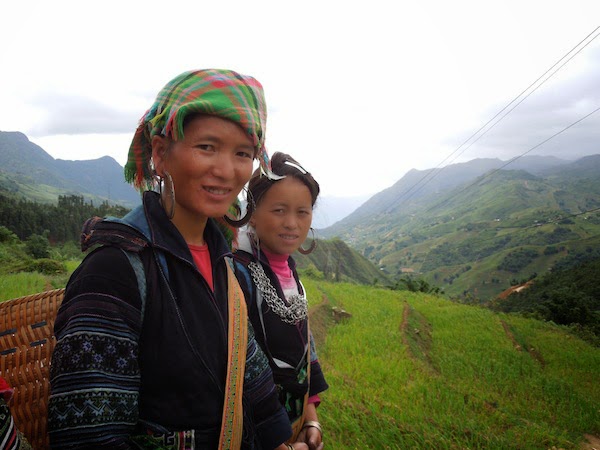
Because besides its scenery and its climate, Sapa is famous for the fact that its hill-tribe women, decked out in hand-embroidered tunics and elaborate, technicolor headdresses, will trek with you. Wherever you go. It’s what they do, day in and day out, their children strapped to their backs and their conversation topics at the ready. They latch onto a group of passing tourists, ask them their names, and follow them all day chatting. What’s your name? Where are you from? First time in Vietnam?

It starts off as kind of a charming set-up, really. With all these strangers taking such an interest in you, you get caught up in the spirit of cultural exchange and start answering questions and tossing them right back. The women quickly prove themselves to be so open, and so adept at English, that you can ask them almost anything you want about their culture, their lifestyles, their families, their diets and their language and their traditions. They can tell you what crops you’re looking at and which little hut in the distance belongs to them.

Trekking Sapa 1


It’s like having a dozen personal, native tour guides who want nothing more than to help you understand what you’re witnessing — for about an hour. Then, the sales pitch begins.

By the time these women leave your side – which, for the record, happens at the border of their neighboring tribes’ villages – they’ve invested enough time in you that they expect to get a little something in return. They quickly yank embroidered purses and wallets, handkerchiefs and bracelets and cheesy little plastic toys out of their baskets and demand that you buy something.

And the thing is, I get it. This is how they make a living. I have no problem with the idea of paying a little extra for the privilege of walking with ambassadors from these cultures most of the world doesn’t even know exist. And getting a little souvenir to boot seems like a win-win. At first. But every woman who speaks to you, each one whose smile you once politely returned somewhere along the trail, expects you to purchase generously from her store. Before you know it, you’re surrounded by half a dozen women, each reminding you of all the great times you’ve had over the last hour and telling you, sometimes in so many words, that you’re a bad person for not wanting to buy a matching set of embroidered pillowcases from her.

It only takes a few moments for the aggression to overshadow the fact that you’re still surrounded by the all-encompassing natural beauty you came to see in the first place.

And it doesn’t stop when you get back to town. Women come up to you on the street and hang two steps behind you, peppering you with questions, following you to the ATM and the pharmacy, waiting across the street while you duck into a cafe for a cup of coffee and running back up to you as you come out. “Other women are going to ask you to buy things from them,” they tell you, “but you must tell them you’ll only buy from me because you’re my friend. You’re my friend, right? Now, how much will you pay for this bracelet?” It’s like being on a mobilized 24-hour guilt-trip with a nice backdrop.

By the end of my first day in Sapa, I’d become desensitized enough that I wouldn’t return smiles in the street; I wouldn’t answer any questions as to my nationality or name; I wouldn’t even acknowledge “hellos” with a casual nod. I’d just barrel down the street with what I hoped was a discouraging scowl on my face. And the thing is, I hated it. I’d come traveling to meet new people, learn about new cultures, experience the exotic and the eye-opening, but suddenly I was preemptively shutting myself off to the locals because I couldn’t afford to get to know them. I’d come to Sapa specifically to immerse myself in its stunning scenery, but all I could remember after my first day of hiking was how awful it made me feel.
Trekking Sapa 3

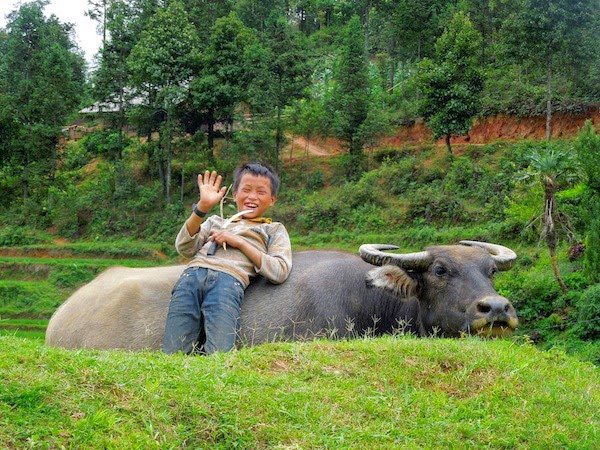
And so, my second day in Sapa, I took a different approach. My second trekking tour with untouched landscapes and zero sales pressure. A local guide, paid handsomely, took our group on a winding trek through the hills and into her own Red Dao village. She took us to the local school, described the rice-harvesting process to us. We saw women cooking outside their homes and little kids riding buffalos along the rice paddies. The whole thing was almost… peaceful.

And then our guide took us to her home to meet her mother in law. And her mother in law’s friends. They gave us little plastic chairs to perch on over the dirt floor, asked us where we were from… and enquired as to wether we’d like to see some handicrafts they had for sale.

Trekking Sapa 5


I definitely do not want to discourage anyone from visiting Sapa. It is truly, stunningly, otherworldly beautiful in the kind of way you only see in tourism campaigns. It’s fascinating seeing how the hill-tribes live, and it’s enlightening speaking with the tribe women – to a point. If you go, just be prepared with an iron will and a scowl in your back pocket — or a lot of cash.

Wednesday, August 6, 2014

A road trip through Dong Van

By Phil D.
The weather was perfect with the sun out shining bright, no clouds and a fresh breeze blowing in our faces as we started to motorbike tour Northern Vietnam. With the best still to come, the scenery was already amazing. As we were climbing up the narrow road, sheer limestone cliffs and surrounding mountains became our constant companions.

Motorbike Northern Vietnam

It was market day and the town was already hustling and bustling in the early hours of the day. Hmong women wearing vivid, traditional dresses filed down from their hilltop abodes carrying all sorts of produce  to the town market. Traders were offering everything from traditional clothing, tobacco, incents, and tea. Farmers steered water buffalo and hogs around the market’s edge. The people were busy haggling and looking for bargains but also happy to meet friends and relatives from other villages. It was busy, colorful and authentic with only very few foreigners around.  We wanted to get a local breakfast and took a seat at one of the stalls set up on the market ground. Freshly cooked Pho, the traditional noodle soup, was on offer, steaming hot and smelling all so tasty.

Motorbike Northern Vietnam

We walked around the market a bit longer and then decided to check out some of Dong Van’s other highlights. We first tried to make our way up to a small hilltop village. The road was really bad and some would actually not even call it road. Just a path carved into the mountain covered with rocks. We passed villagers returning to their villages and we realized how far away some of these people live. To make it to the market, they must have left their villages in the middle of the night. The path became more and more rugged and steeper and we started to worry about our precious bike. We finally decided to turn around not knowing if the village was still far or just around the next bend.

Motorcycling Northern Vietnam 3

The sky cleared up and we decided to drive up to Lung Cu where the Vietnamese set up a huge flagpole on top of a hill overlooking China. The outlook of actually seeing China from up there was intriguing, but unfortunately we never made it. Once we pulled into town, we were escorted by a police officer on a motorbike to the local station. Apparently we had to register with them first. To our dismay we realized that our permits were inside our passports which we had left at our hotels reception. There we were, in a Vietnamese police station confronted by a grumpy official, in the middle of nowhere. Not a good feeling and when he let us know that we would have to instantly go back to Dong Van, we were actually relieved that we didn’t have to face more serious consequences. So if you think you can easily go without a permit, don’t do it. At least if you plan on venturing a bit out of Dong Van and Ha Giang.

Tuesday, August 5, 2014

Cycling Southern Vietnam

By Dan Moore 
Welcome to our last installment of Tour de Vietnam, where we share photos taken from the cycling lane. (In case you missed it, you can check out our snapshots from the North and Central region as well.) A massive thank you to everyone who has commented, tweeted, sent words of encouragement and virtual high-fives, and basically kept us inspired throughout our trip. Cycling Vietnam sure wasn’t easy, and if it’s wasn’t for you we might have found ourselves on the first bus barreling past. 

Seriously, you guys rock! This is our last installment of Tour de Vietnam, but we have an extensive post cram-packed with anything you could possibly want to know about cycling Vietnam coming at ya on Thursday. We are covering everything from how to buy bikes to cycling itineraries to where we slept and how we found toilets. If you have specific questions you want answered, send them our way and we will address them. Again, thank you for joining us on our journey. Hope to have you along for many more! And now, here’s a glimpse of Southern Vietnam!

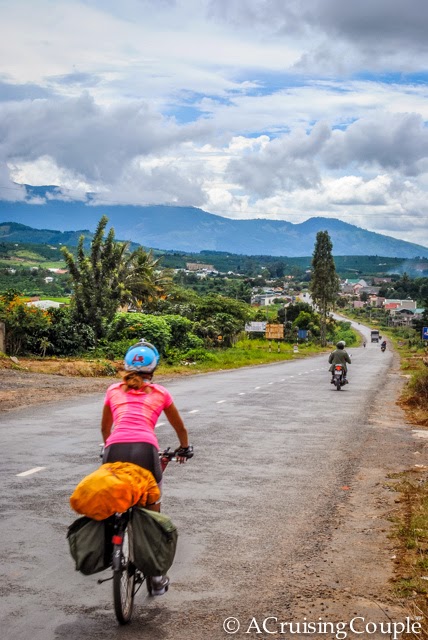
Cycling Vietnam 1


Cycling Vietnam 2 


Cycling Vietnam 4


Cycling Vietnam 5


Cycling Vietnam 6


Monday, August 4, 2014

The Perfect Halong Bay Trip

By Lina Eroh
Halong Bay, with its 1000s of limestone cliff "islands," is a must for any visitor to Vietnam. Seeing the pictures is one thing, but actually looking up and around you and seeing nothing but sheer rock coming out of the water is quite another. If it's solitude or adventure you're after, it's all here at Halong.

Kayaking Halong Bay 1

The one must that your tour should provide is kayaking Halong Bay. This is, rightfully, almost everyone's favorite activity as it allows you to freely explore the caves and grottos carved out by the water. We kayaked into the "James Bond cave," which was featured in Tomorrow Never Dies, and then spent another hour just exploring the various nooks within the rocks.

Kayaking Halong Bay 2

If you want a more adventurous trip, opt for a one-night on boat, one-night on island package. That way you can do some trekking and additional kayaking in a different bay.

If you want a more relaxing trip, opt for two nights on the boat. I actually wish we had done that, because all the transfers on the second day take a while and kill the atmosphere a bit.

Kayaking Halong 3

Our trip, with Monkey Island Cruises, took us to Monkey Island the second day. It was okay, but the water around it was filled with trash and the "superior" bungalows were tiny and lacked any view. The pouring rain didn't help matters.

One benefit of all the transfers is the drive through Cat Ba Island, which is the only populated island in Halong. Lonely Planet calls it "something straight out of Jurassic Park," and in this instance, they're right. Besides for the one town and road, the locals have largely left Cat Ba to the elements, which means it's a mix of jungle, rock, tropical rainstorms, and fog that rivals San Francisco's. In short, it's a hell of a 40-minute drive, and probably the best part of our trip to Monkey Island.

Sunday, August 3, 2014

THE ANCIENT CITY AND DELICIOUS CUISINE OF HOI AN

By Rob and Lina Eroh
Hoi An and Hue, both recognized by UNESCO for their historical and cultural significance, offer the casual visitor plenty of postcard perfect views, plus more delicious food than you can handle for just a few dollars. If you have limited time, travel to Hoi An, as it's best a place discovered over a few days. Those with five days on the central coast should try to stop at both Hoi An and Hue, as there's tons to see... and even more to eat!

We just walked around town  and admired the architecture of the old buildings. Though most are now restaurants or boutiques, they still retain the design from when they were built in the 15th to 19th centuries. Since receiving the UNESCO designation.Hoi An has essentially stopped modernizing and now capitalizes entirely on its past.

Travel Hoian 1

If it's too hot to walk around, rent a bike and head to the beach, 5km away. It's a really pretty ride and the beach is clean, with plenty of shade. We spent our first day there, and were surprised with a pretty crazy sunset at the end.

Travel Hoian 2

If you have more time to linger, you can also take your bike across the river to Cam Kim island. Take the local ferry across instead of paying for a tourist boat and get lost amidst the rice paddies and boat building shops. Real Vietnam is right here, only 10 minutes away from touristy Hoi An, and it makes for a nice few hours of cycling Hoian.

Travel Hoian 3

Most people agree that Hoi An has the best food in all of Vietnam. I can tell you that we agree, even though we never really ate at a restaurant. The beauty of this town is that you can spend a few dollars on the street and have the most amazing meals ever.

Travel Hoian 4

The banh mi (sandwiches) are better than anywhere else in the country, with thick bread that actually has a crunch. The local specialty of cau lau, sliced pork over thick wheat noodles, is out of this world, at least according to Rob. The banh vac, or "white rose" shrimp dumplings, are delicious, and almost everywhere offers glasses of bia hoi (draft beer) for $0.12-0.50! You really can't go wrong.

The only restaurant we ate in was the iconic Cargo Club on the main street. We split a continental breakfast, which featured the best croissant in SE Asia. That's not saying much, but it was a LOT better than anywhere else. We ate all of our dinners at the stalls that pop up by the river, on the other side of the Japanese Bridge. Entrees ranged from $1-2, and everything was delicious.

The liveliest spot for drinks is Before and Now, which offers "ladies night" specials of free cocktails at exactly 10:15pm. Random, but my gin fizz was really good and came with a fun straw. Our favorite place for drinks, however, wasn't a bar at all, but a boat on the river that at night became a hot spot for travelers. Here you can listen to live music, have great conversation, and have bowls of beer for $0.50!