Showing posts with label trekking Vietnam. Show all posts

Wednesday, August 20, 2014

Trekking Solo in Vietnam: Mt. Fansipan

By The Mind Room
Traveling alone in Vietnam kindles a love for the unknown and unpredictable. Modern Travelers follow in the steps of many past explorers.

It’s 4:30AM, and we whiz over Vietnam’s dusty mountain roads on a tiny red motorcycle. My trail guide, Chah (5’1), revs the engine, and I cling shamelessly to his waist from behind. Every time we zoom around a tight curve, our entire outfit tilts precariously and threatens to fling my unwieldy 6’4 body off the narrow seat. Even though my Ichabod Crane-like knees jut out awkwardly, our speed is exhilarating. The preliminary rays of dawn are just beginning to illuminate the peaks above us, and we pass teetering fruit trucks and groups of colorfully-dressed Black Thai women jingling towards Sapa with baskets of hand-made trinkets.
The trailhead is an abandoned colonial French outpost in the middle of northern Vietnam's Hoang Lien Mountains. I pause for a few perfunctory stretches while Chah glances impatiently at me and then at the trail. I strap on my locally-purchased, counterfeit North Face daypack and clench my Black Diamond hiking poles. I'm ready to conquer Fansipan, one of Southeast Asia’s highest peaks.


Arrival

Not bothering to research the mountain’s location beforehand, my China Southern Airways flight lands me in Saigon (Ho Chi Hinh City) in southern Vietnam. It doesn't take long to figure out that Fansipan rises in Vietnam’s far north near the Chinese border. Doh! Looking at a map, I realize that I have a 2,000-kilometer journey, no knowledge of local languages, and no friends in the region. With only 13 days, I also have no time to waste.

From Saigon, I board what I think is a nonstop bus to Hanoi. Dozens of tourists and locals board the blazing red, and eight hours later we arrive at beach-city Nha Trang. Standing alone on an unfamiliar street corner, I watch nervously as the bus shuttles back towards Saigon. “Are we going to Hanoi?” I ask with trepidation. “Yes. Tomorrow night.” I've traveled in the developing world before and know never to depend on a detailed itinerary. Three days, three buses, and several more impromptu stops along the coast later, we finally reach Hanoi.

1647 kilometers down; 336 to go. My ever-helpful Lonely Planet guide leads me to Hanoi’s train station for a ticket to Sapa, the mountain town nearest to Fansipan. A German woman, flanked by a careworn husband and two terrified-looking children, yells angrily at an attendant in the station's lobby. I shuffle past and board a railcar: room 4, number 14. Five hours on a cabin bed is easy; my bunkmates, a friendly, middle-aged Singaporean couple, tell me all about their love for cruising their Harley Davidsons through Thailand. Afterwards, I nestle under my sheets and even manage to get some much-needed sleep.

The final, 2-hour bus ride from our mountain train stop drops me off in the middle of quant Sapa, an old Bavarianesque vacation spot for French colonials. I easily find a $5 dollar-a-night lodging at the sparse, but cheerfully managed Pinocchio Hotel and stretch out on one of the three beds in my room. Success! I appreciate the fact that I am in Vietnam’s northern mountains with plenty of time left to get trekking Fansipan. Suddenly, 2,000 kilometers of cramped and uncertain travel seems well worth the trouble. 

Hiking the Fansipan Trail
 

At first, the trail descends down several steep drops into a shallow canyon and passes a drying streambed that reminds me of scenes from The Thin Red Line. The hardened clay ground makes for sturdy steps, but the trail is clearly not maintained. We constantly maneuver around washed-out gullies and clamber up near-vertical inclines. At the far end of the canyon, the path climbs relentlessly upwards. Chah bounces effortlessly from rock to rock and tells me about his family. Looking younger than I am, he already has a wife and several children; they live with his parents in a neighboring mountain village.

Fansipan (10,312ft.) is often called the rooftop of Southeast Asia, and I am almost completely unprepared physically for the hike. Lonely Planet advertises only two local backpacking options: a strenuous three-day trip and the exhausting two-day option. The day before, I strolled into a cavernous touring shop punctuated only by a small school desk and chair. The elfish man behind the desk offered an unexpected alternative: “Would you like to hike Fansipan in one day?” Not backpacking would render 80% of my luggage unnecessary, but why not? I take it as a dare.


Chah darts ahead and skips gracefully from step to step. He shouts back at me, “Come on!” as I struggle over a lengthy and precipitous slope. The topography is confusing. Before coming to Vietnam, my impression was that the entire country is covered in uninterrupted jungle. Even though everything is green in northern Vietnam’s mountains, the forests are thin and leafy. We are also constantly surrounded by blackened earth and the burnt husks of dead trees. Chah explains that, at lower elevations, the hill tribes periodically burn the forests in order to discourage undergrowth, avoid wild predators, and clear land for agriculture. Far removed from the constraints of such a life, I am disappointed. The only “wildlife” we see on the entire hike are three bored cows chomping a bush.

As we gain altitude, the woods thicken. The morning fog starts to dissipate and the jagged edges of slim mountain ranges appear above us. Beautiful ribbons of mountains connect and separate in all directions; ridgelines are barbed and dramatic. We scramble up mud-covered and slippery ravines. Suddenly, we reach the foot of the range’s razor-edged backbone, and the trail becomes discernibly maintained with clumsy side rails and an even path. The going is slower as the trail ascends more quickly, and I take my time clinging to the rails. I pause for a moment to take in the vistas. “Come on!”

Previous trips with friends in the developing world gave me confidence to set out on my own. Traveling solo through Southeast Asia stirs unwanted but somehow alluring memories of the first European explorers in the area. Milton Osborne’s The Mekong outlines their adventures. After securing a trade empire based at Malacca (in present-day Indonesia), Portuguese explorers plodded throughout the region’s interior by the mid-16th century. Names like Tome Pires, Antonio de Faria, and Ferdinand Mendez Pinto appear who explored the coastlines of present-day Cambodia and Vietnam in the 1540s. Contemporary maps of the continent’s untamed interior attest to their forgotten exploits seeking trade, wealth, and conversions to Christianity. I imagine the wonder these men must have felt as they traveled in such distant and untouched native societies and contexts. Every sight was a new discovery; every jungle bend presented these men with something new to grapple with and understand.

I briefly begrudge the mass communication of our internet age for spoiling Vietnam’s many unique surprises. Before disembarking from my plane at Tan Son Nhat International Airport, Google Images already illustrated the sights of Vietnam to me: the peoples’ dress, the natural scenery, and even my journey’s probable obstacles. But venturing out alone without a detailed plan rekindles an adventurous spirit of the unknown. Topography and cities are new; relationships are always novel, and never knowing what to expect next is invigorating. Even in a modern age, travelers can catch a glimpse of 500-year-old adventures. Never mind the every-moment control we exercise over our lives here in the United States; in Vietnam, I am immediately addicted to the risky unknown.

Mt. Fansipan, Vietnam

The trail’s last push is extremely difficult. My legs and chest sting with pain, but I scramble up a muddy embankment encased with dense, leafy ferns and trees on either side. Chah disappears somewhere ahead. Suddenly, the peak appears out of the mist in front of me. I made it! The jungle stops at the base of a 50ft.-high pile of rocks at the summit, and I carefully wobble to a perch at the pinnacle. Two Australian cyclists are eating a snack with their guide, and we chat briefly about trail conditions. After they leave, Chah and I gaze out across the mountain range. Chah tells me that Dien Bien Phu lies further west. Sapa is hidden 20 miles north.

Conquer Fansipan 2

A small, silver pyramid marks Fansipan’s apex and predictably reads: “Fansipan/3143m”. I sit next to a nearby statue of the Buddha which someone cemented onto the rock. On his pedestal lie an orange, a mummified apple slice, and a package of four cheese-filled crackers. I snap a few pictures and relax. Hooray! Only five days ago, I arrived at the wrong side of Vietnam. I close my eyes and wonder what I should do next with the remainder of my time here. Before I can finish my thought, I am interrupted by Chah’s shrill voice: “Come on!”

Wednesday, July 16, 2014

How to trek Sapa in right way

By Robyn
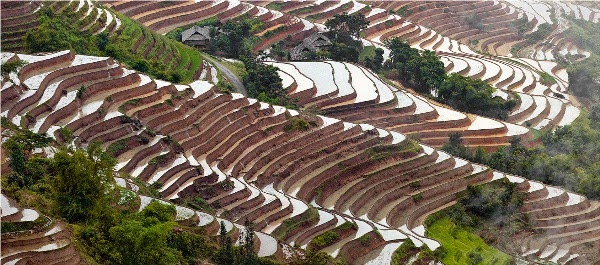
Sapa is renowned for its phenomenal trekking Vietnam. Hills stretch into the clouds and valleys plummet to the floor with such speed and force that it is hard to imagine how people manage to live off the land. Yet, as far as the eye can see, steps of rice paddy fields stretch across these astounding gradients with such precision and innovation that could only have been created by the resilient Vietnamese.

Trekking Sapa

The rice field hills are an awe inspiring spectacle only to be broken by the occasional waterfall, nestle of jungle or bamboo forest, making it the ideal place to go trekking Sapa.  But unfortunately, like so many wonderful parts of the world, it has become very cramped with tourists and subsequently hagglers and other annoying quirks that follow the industry. Sadly it is very easy to go to Sapa and have a very shallow experience, superficially coated with unauthentic tourist fluff instead of the real deal. Here are a few tricks to make sure you have an authentic trekking experience.

Trekking Sapa Vietnam

There is no better way to understand someone else’s culture than to be invited into their home for a night. And the fascinating minority tribes of the Sapa region are no exception. You won’t get a toilet but if you’re happy to squat behind the bamboo you will not only get a loo with a spectacular view but you will have a much more exciting story to tell when you get back home. The bed will be warm, hard but warm, and the food will be fantastic. So keep an open mind and learn what it is like to survive on the hills of Sapa.

From rain, to heat , to freezing conditions. Make sure your overnight bag has it all. Of course it depends on what time of year you go as the weather does vary – but even though the days may be warm and sunny the temperatures can drop at night to extremely cold conditions. Make sure you have a clean set of clothes to sleep in as it is highly likely that everything from your socks to your t-shirt will be caked in mud by the time you have finished your first day of trekking and throw in a waterproof jacket or umbrella in case it suddenly decides to rain. Then it’s all the usual; torch, toilet paper, camera, water.

Wednesday, June 25, 2014

Unforgetable homestay and trekking Sapa, Vietnam

By Anna Baldwin

My next stop after Hanoi was to jump on the night train in search of the stunning paddy fields of Sapa. As the train pulled out of the station I said goodbye to the noises, lights and smells of the bustling Hanoi streets and settled into my cosy cabin as we set off north towards China. The cabins are generally made up of four beds- 2 sets of bunk beds- but often if travellers want a bit more privacy and space we are able to book the whole cabin for them. I was lucky enough to be joined by a lovely German couple, along with their local guide, and we spent the next couple of hours talking and exchanging food as the train made its way deeper into the vast countryside.

The train soon lulled me into a deep sleep, and before I knew it we had arrived at Lao Chai station, our last stop on the train before it returned south to Hanoi.

Although it was barely dawn, the station exit was surrounded by taxi drivers, guides and hawkers ready to pounce, but I soon found my local guide, Dong, who pulled me through the crowds and into our 4X4.  Within a few minutes we were off on the hour-long drive to Sapa town. It was a stunning drive as we slowly climbed higher and higher towards Sapa, where we soon reached a height of 1,600m! Surrounded on all sides by paddy fields dotted with numerous tribal villages, Sapa is very much a mountain town, with its steep roads filled with shops selling trekking gear and rows of balconied wooden houses overlooking the dramatic landscape beyond.

Trekking Sapa 1
Impressive trekking Sapa
After some breakfast and last minute tour preparations we set off with our wonderful local porter Sing, who was to carry all our food and drinks for the next three days, and we drove to the beginning of the trek – Ta Van village.

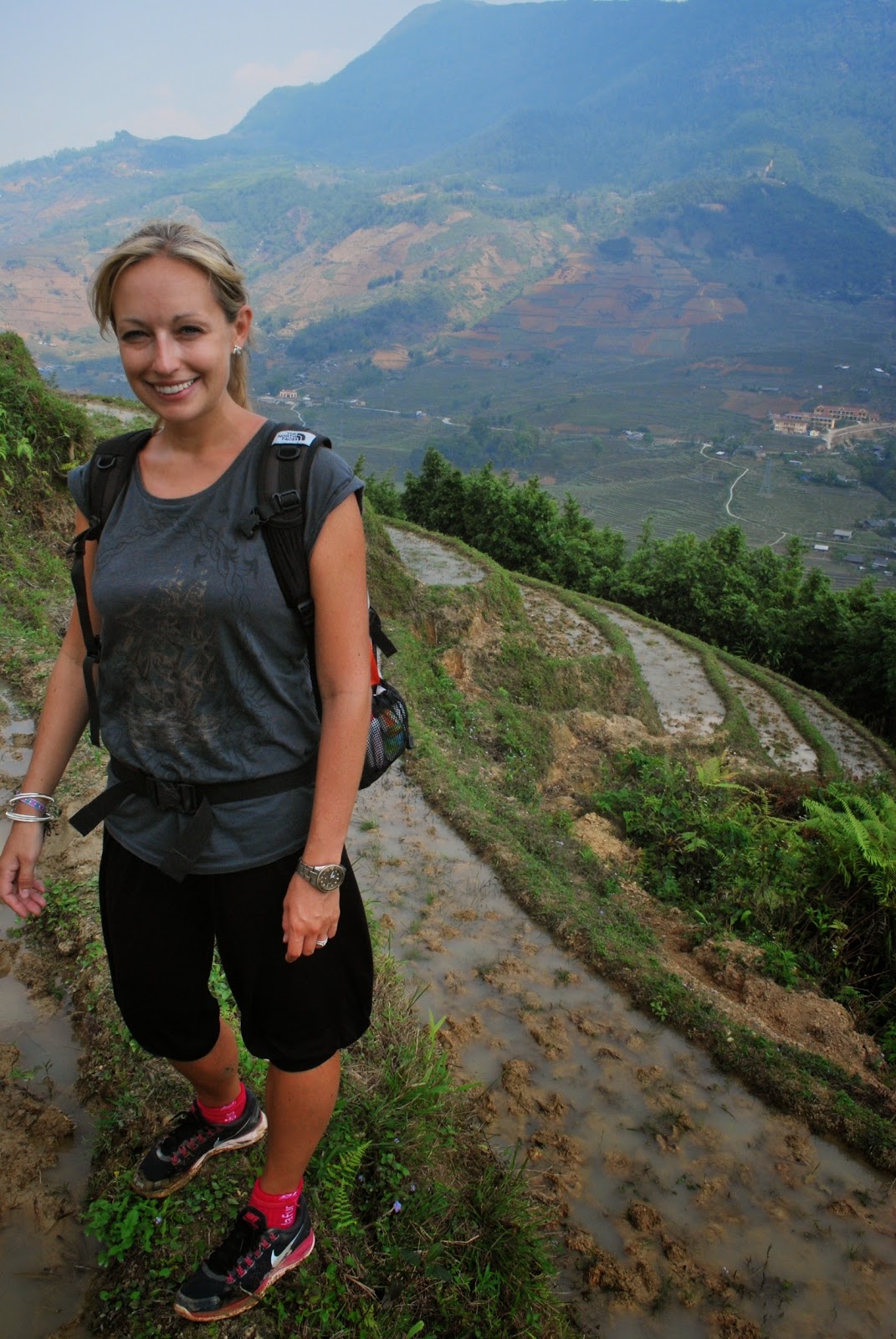
We soon left behind the Dzay village of Ta Van and set off along the valley. This is where I truly tested my balancing skills, as we made our way along narrow paths and the edges of the paddy fields which lined the mountainside. Luckily two lovely local ladies came to my rescue; half my size and twice my age, they obviously make a habit of adopting the most hopeless-looking trekker to make sure they don’t fall face first into the flooded paddy field below.

Trekking Sapa Vietnam 1
Black H'Mong ladies
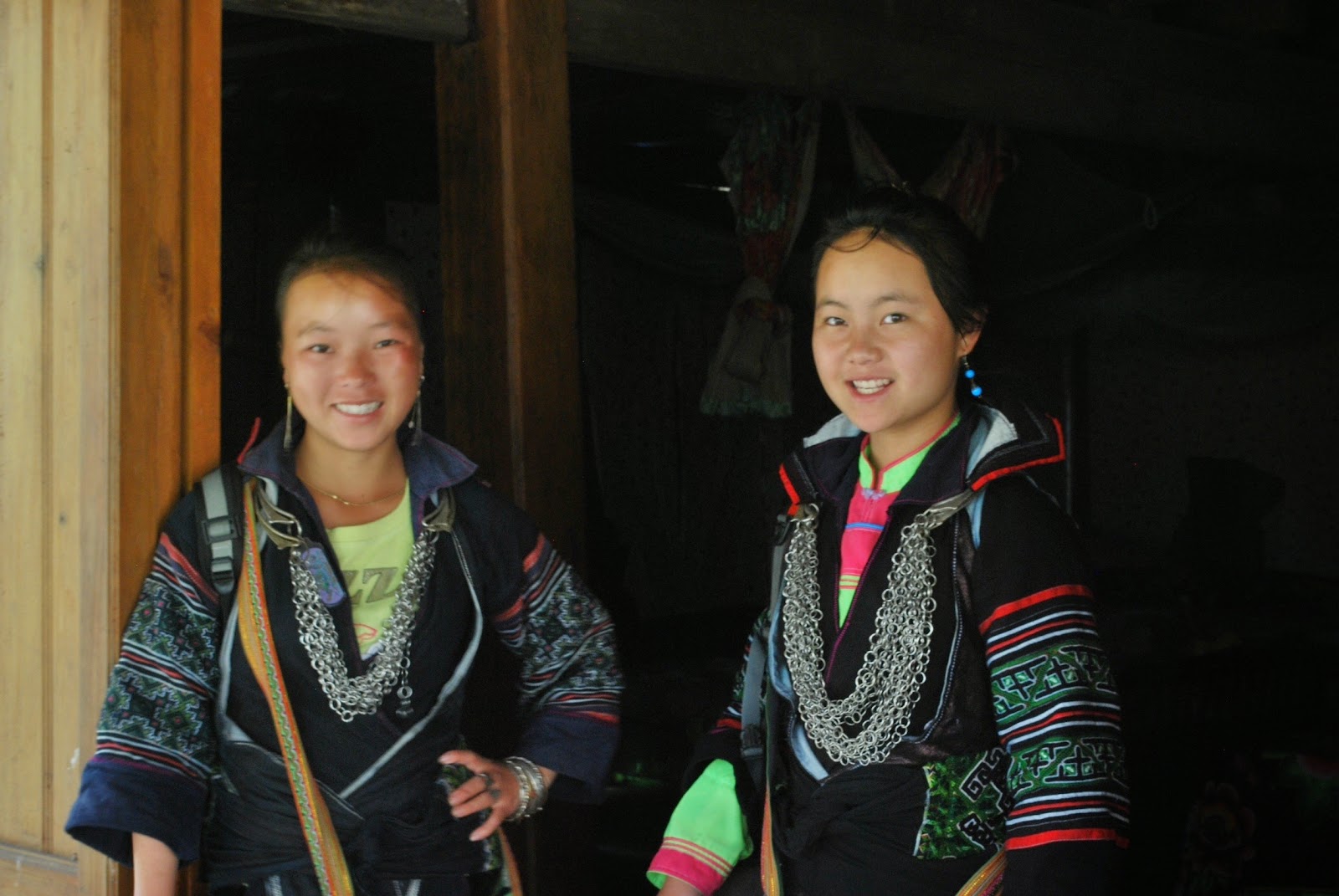
The route took us through a number of different tribal villages, from Red Dao to Black H’Mong, who wear mainly black clothing as their name suggests.  The dye in their clothing often runs and so, as a result, their hands are also stained a little black.

After a long but stunning trekking Sapa, we eventually arrived at Seo Trung Ho Village, our base for the night. Never before had I seen such a dramatic, remote location for a village. In one direction you will find a magnificent waterfall thundering away behind the village, and the other provides breathtaking views across the valley with the misty mountains in the distance. There’s not a tourist in sight…

Trekking Sapa , Vietnam 2
Terrace field , Sapa Vietnam
After an evening of rice wine and delicious home-cooked food, I went to sleep in my homestay Sapa with the sound of the waterfall and the light patter of rain.Rice wine and home-cooked food, not a bad combination after a good day's trekking Sapa tour.This light patter was hugely magnified by morning as I woke to find we’d had heavy rainstorms all night and the waterfall was twice the size!

This resulted in making our morning route a little too unpredictable with the wet conditions, so it was decided we would do that morning by motorbike. Another unforgettable experience trekking Sapa tour – driving down from the village into the valley, through the river, and up onto the other side, slowly picking our way through the roads with awesome views all the way down the valley to the distant mountains. Suddenly the sun came out and the clouds disappeared, and I could see for miles. As we drove further along the valley I looked back and was thrilled to see the magnificent ‘’Roof of Indochina,’’ Fansipan Mountain, the tallest mountain in all of Indochina. I thought – I’ll save that one for next time trekking Vietnam


Thursday, November 7, 2013

Cuc Phuong offers a break from city buzz

Cuc Phuong National Park, the first national park in the country, is a relaxing place for tourists to enjoy a few days exploring tropical rainforest and a wonderful place to escape to and provides the perfect backdrop for profound thoughts and musings about life. 

Trekking Cuc Phuong National Park
Established in 1962, the 22,000ha forest stretches across three provinces: Ninh Binh, Hoa Binh and Thanh Hoa. Cuc Phuong hosts more than 2,000 kinds of plants, 2,000 kinds of insects, 122 kinds of reptiles and amphibians, 65 kinds of fish, and 133 kinds of animals. 

Before reaching the forest, deep inside the Tam Diep mountains, the local motorway leads travelers through Ninh Binh's karst mountain ranges, where they can enjoy scenic lakes, caves and rice fields and glimpse the lifestyle of northern countryside farmers. 

A stop at big fields feasts the eyes on immense green young rice paddy and scattered lakes where herds of ducks and buffaloes swim. The peaceful villages are bordered with ranges of karst mountains. 

Yet the most relaxing moments are inside the forest, whether they are riding a bicycle along the lanes, jogging around Mac Lake near the entrance of the forest or trekking to the 1,000-year-old cho xanh (East Indian almond tree, or Terminalia Myriocarpa). 

Trekking Cuc Phuong National Park
The pleasant 3km walk to the tree offers some interesting lessons on wildlife. Equipped with trekking shoes, long-sleeved shirts, hats and water, necks and arms soaked with mosquito repellant, the travelers followed tour guider along the path. 

The smell of wild grass and the moist air and absolute quiet of the old forest drew them in. It seems that time had stopped. There was no signal in our mobile phones. Deep in this forest, they were one with nature. 

A green twig was moving in the green. Tour guider explained that it was an insect called bo que, or walking stick (carausius morosus), famous for its capability to camouflage itself in the environment. 

"Such an insect can disguise itself as a green twig or a brown one depending on the tree that it lives in," adding that there are 25 species of that insect in Vietnam, of which 20 can be found in Cuc Phuong. An adult "walking stick" can reach 60cm in length. 

Through a vast land populated by wild banana, the guide said it was the most reliable source of fresh water in the forest. "Water from wild banana trunk tastes pretty acrid but it is safer than water from streams,". 

"If you get lost, you can cut a wild banana trunk 20-30cm from the ground, make a horisontal hollow in the middle of the trunk and wait a few minutes. The water will soon come through the banana root to fill the hollow," he said, pointing to a wooden climber running along the path, flying from tree to tree, and said it was called day bam bam (woody liana). The longest one in the forest runs 2km long, he said. 

Trekking Cuc Phuong National Park
Passing some small springs, deeper into the dense forest, tour guider stopped at a banyan tree that almost completely covered the weak tree below. He explained that many banyan seeds were brought by birds to host trees. The seed grew thanks to nutrition from the host tree, which it gradually swallowed. For this reason, banyans were sometimes called "tree killers", he said. 

The environment might look friendly to tourists, but for animals and plants there was fierce competition to survive. After more than one hour, they finally reached the famed thousand-year-old tree, which measures 45m in height and 5.5m in diameter. From the wide root emerge two steady trunks, which stand firmly on the ground and grow stunningly tall. 

Travelers enjoyed the scarce rays of light leaking through dense layers of leaves as they returned to the car park, felling happy that we had done exactly as the forest management reminded: "Leave nothing but footprints, take nothing but photographs."

Source: VNA

ACTIVETRAVEL ASIA would like to recommend Trekking Cuc Phuong National Park tour.This tour offers a great opportunity to discover the rich fauna and flora of Cuc Phuong National Park, the most important site for biological research and conservation in northern Vietnam. The challenging trail combines with unique home stay experience making this tour is a real eco & community support tour for those who want to travel actively and responsibly.The second day is relaxing with a boat trip to see the unique “Halong Bay on the rice field” before heading back to Hanoi.
Highlights :
  • Primate Rescue Centre
  • Jungle trails
  • Homestay in village
  • Thung Nang - "The Halong Bay on the rice field"

Monday, May 13, 2013

Cuc Phuong National Park, Vietnam offers escape from humdrum city life

For the first time in months, I concentrate on breathing the clear fresh air, relax and feel my tense muscles unclench. Finally, I can hear myself think and am alone, surrounded by nature and centuries of evolutionary miracles.

Trekking Cuc Phuong National Park
Such a welcome break from the buzz of Hanoi. The sound of birdsong disturbs the silence. That's right, complete silence. Such a welcome break from the buzz of Hanoi. No motorbikes, no horns, no market vendors yelling, no drilling. Just complete and utter silence.

I have come to Cuc Phuong National Park, after a 90 minute motorbike ride from Ninh Binh City. After leaving the city, the road winds its way through small villages surrounded by rice paddies. Soon the houses give way to more rice paddies, interspersed with stunning limestone karsts. The landscape is very similar to the karst formations of Northern Vietnam's Ha Long Bay, yet, due to its in-land location, obviously lacks the marine features of its coastal counterpart.

Cuc Phuong national park
Cuc Phuong is Vietnam's oldest national park and was established over 50 years ago. The scenery that unfolds before my eyes is breathtaking, and the calls of insects, birds, and primates lure me into the dense forest. On walks I explore the park's extensive trekking trails, listen to the mystical sounds of the jungle and visit some of the villages in the area, where I could see some of the traditional stilt houses, agricultural tools and, luckily, musical performances by some of the region's ethical minority groups.

The park is also home to some of the region's most successful conservation centres, where injured and confiscated animals from the wildlife trade are rehabilitated and prepared for their re-release into the wild.

Visiting the Endangered Primate Rescue Centre was my highlight, and I spent close to two hours watching over 100 primates of over 15 different species of gibbons and langurs play, feed and nurture their young. At the Turtle Conservation Centre close to 20 different turtle species that have been rescued from the wildlife trade are housed and bred, and possibly will be re-introduced into the wild eventually.
Turtle
Endangered Primate Rescue Centre
As most of these species are endangered, the conservation centre also functions as a place of education and provides vital information about the key turtle species in Vietnam. For example, did you know that it can take up to 30 years for a turtle to hatch from an egg, mature, and procreate? The life cycle of these stunning creatures is unbelievably slow, and sadly the high demand for turtles (as pets or meat) is devastating turtle stocks across Vietnam.

Cuc Phuong National Park - mushrooms
The Small Carnivore and Pangolin Conservation Centre next door is home to some of the most endangered small mammals in Vietnam, such as the Owston civet or leopard cat.

After visiting all three centres and learning about the natural heritage and biodiversity of Vietnam, I walked back to my lodge contemplating the beauty of it all: the landscape, the conservation efforts of so many dedicated individuals and organisations, the fascinating species of animals and plants that are unique to this part of the world, and our role of humans within it all.
Faced with such spectacular surroundings, I felt very small. Standing there, alone, in the middle of thousands of years of evolutionary processes, I couldn't help but wonder what the future would bring – would we as humanity manage to come together to preserve our natural beauty, or would we continue in our path towards destruction and extinction? I guess only time will tell.

Thousand year old tree
However, I can say for certain that Cuc Phuong National Park is a wonderful place to escape to and provides the perfect backdrop for profound thoughts and musings about life.

You can book a trekking tour to explore Cuc Phuong National Park though travel agencies in Hanoi. I can recommend an adventure tour operator I knew, ACTIVETRAVEL ASIA. They offer adventure tours at Vietnam, Laos, Cambodia, including hiking and trekking, biking, motorcycling and family travel packages.
You can refer Trekking Cuc Phuong National Park Tour via: 
http://www.activetravel.asia/trekking-cuc-phuong-national-park-t275.html