Beautiful beaches, year-round green tropical parks, mighty rivers, unique fishing villages, special culinary characteristics ... are always the force of gravity of Vietnam in the eyes of foreign travelers.
1. Hanoi
Voted by Smart Travel Asia magazine as one of the most attractive destinations in Asia, Hanoi has its own charm to attract domestic and foreign tourists.
Throughout the thousand years of its eventful history, marked by destruction, wars and natural calamities, Hanoi still preserves many ancient architectural works including the Old Quarter and over 600 pagodas and temples. Famous sites include the One Pillar Pagoda (built in 1049), the Temple of Literature (built in 1070), Hanoi Citadel, Hanoi Opera House, President Ho Chi Minh's Mausoleum...
Hanoi also characteristically contains 18 beautiful lakes such as Hoan Kiem Lake, West Lake, and Truc Bach Lake..., which are the lungs of the city, with their surrounding gardens and trees providing a vital source of energy.
Many traditional handicrafts are also practiced in Hanoi including bronze molding, silver carving, lacquer, and embroidery. Hanoi has many famous traditional professional handicraft villages such as Bat Trang pottery village, Ngu Xa bronze casting village, Yen Thai glossy silk...
2. Sa Pa
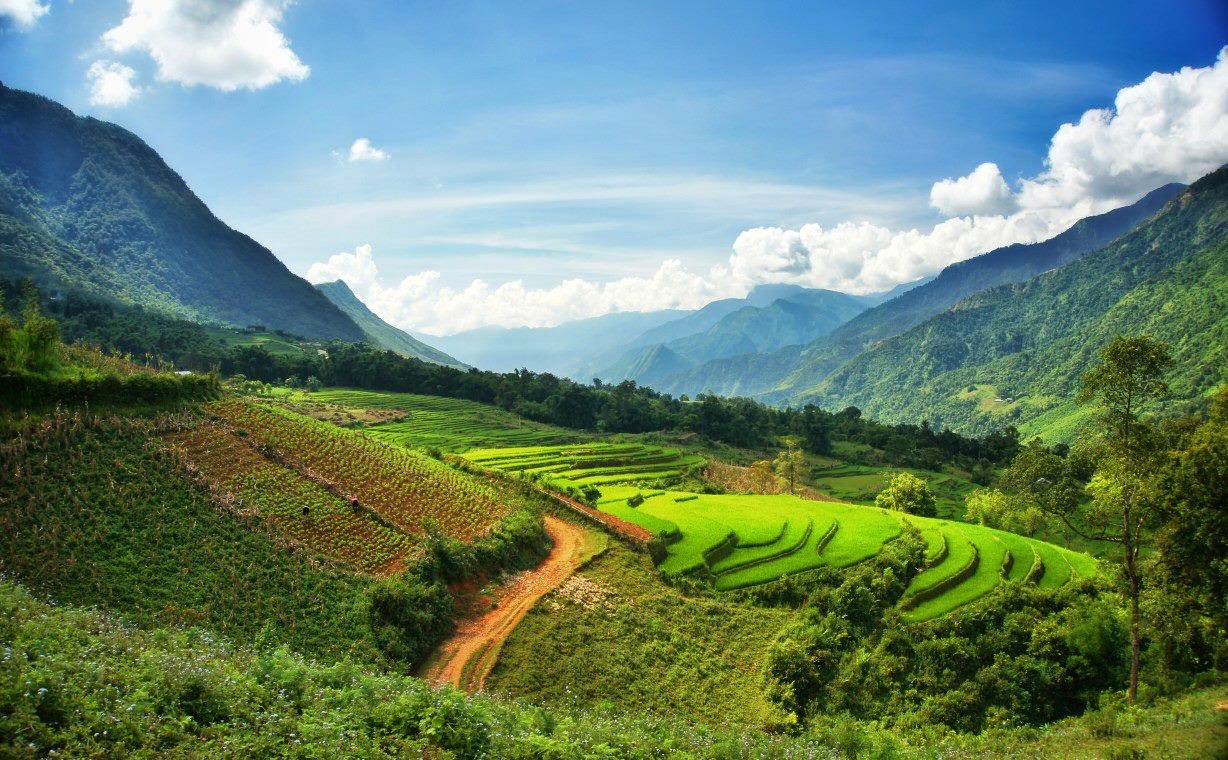
Cool climate all year round and the beautiful natural landscapes are the most charming features of Sa Pa.
Sapa Vietnam is a favorite attraction to tourists, both domestic and foreign thanks to its beautiful scenery and colorful culture. The French used to consider Sapa as Summer Capital of Northern Vietnam in the early decades of the 20th century. Its naturally gifted beauty keeps attracting more and more people to spend their vacation there since then.
Aside from leisure pace of sightseeing and exploring the diversity of culture in Sapa, this is also an ideal place for more adventurous tourists with many trekking tours available. Or, you can also do some trekking on your own and stay with the hill tribes for an insightful understanding of the ethnic groups here.
April and May are the best time for tourists to watch the most scenic beauties of Sapa, or else it might be cold and foggy before that and rainy after that. During these two peak months, the town is blossoming with pink and white flowers, and green pastures in valleys. The clouds that settle in the valley in early morning would quickly disappear.
Most tourists agree that it would be regretful if the leisure and relaxation time in cool and fresh weather is not accompanied by visiting trips to Sapa's prideful natural beauty spots, such as Ham Rong Mountain, Silver Waterfall, Rattan Bridge, Bamboo Forest and Ta Phin Cave.
Sapa is home to various families of flowers of captivating colors, unique in the vast country. When Tet, the Lunar New Year Festival, comes, the whole township of Sapa is filled with the pink color of peach blossom brought from the vast forests of peach just outside the town. Sapa is regarded as the kingdom of orchids as well.
Foreign tourists are actually fond of scarce and precious specialties of Sapa, such as forest's product, handicrafts, delicacies (smoked meat, "thang co", "cai meo", san lung wine, corn wine, etc.), typical of ethnic minority people.
Local markets are the town's typically cultural element, which are always crowded and joyful, attracting hundreds of visitors. This is the common place for minority groups to gather and exchange goods. Market sessions are also a chance for local people to promenade. No foreign visitor could help joining such a market session, a typical cultural element of Sapa. What’s more, tourists coming to Sapa at weekends have the great chance to learn about local ethnic people's courtship and martial life, through the Sapa love market and wife kidnapping ceremony of the H'Mong group. The ceremony will begin on April 29th.
3. Halong Bay
Imagine 2000 or more islands rising from the emerald waters of the Gulf of Tonkin and you have a vision of breathtaking beauty. Halong translates as ‘where the dragon descends into the sea’, and legend claims the islands of Halong Bay were created by a great dragon from the mountains. As it charged towards the coast, its flailing tail gouged out valleys and crevasses. When it finally plunged into the sea, the area filled with water, leaving only the pinnacles visible.
Designated a World Heritage site in 1994, this mystical landscape of limestone islets is often compared to Guilin in China or Krabi in southern Thailand. In reality, Halong Bay is more spectacular. The bay’s immense number of islands is dotted with wind- and wave-eroded grottoes, and their sparsely forested slopes ring with birdsong.
Beyond a boat cruise, visitors to Halong also come to explore the caves. There are few real beaches in Halong Bay, but Lan Ha Bay has idyllic sandy coves a short boat hop from Cat Ba Town.
Sprawling Halong City is the bay’s main gateway, but the raffish collection of high-rise hotels and karaoke bars is not a great introduction to this incredible site.
Most visitors sensibly opt for tours that include sleeping on a boat in the bay. Some travellers dodge Halong City and head straight for Cat Ba Town, from where trips to less-visited, equally alluring Lan Ha Bay are easily set up. Cat Ba Island can also be a good base for visiting the landscapes of Halong Bay itself.
As the number-one tourist attraction in the northeast, Halong Bay attracts visitors year-round. February to April is often cool and drizzly, and the ensuing fog can make visibility low, but also adds an ethereal air. From May to September tropical storms are frequent, and year round, tourist boats sometimes need to alter their itineraries, depending on the weather. Some tour companies offer full or partial refunds if tours are cancelled; check when you book.
4. Cu Chi Tunnels
Cu Chi Tunnel is 70 km from Ho Chi Minh City in the Northwest. It is miniature battle versatile of Cu Chi’s military and people during the 30-year struggle longtime and fierce to fight invading enemy to receive independence, freedom for motherland. It also is the special architecture lying deeply underground with many stratums, nooks and crannies as complex as a cobweb, having spares for living, meeting and fighting with total lengths over 200 km.
Real legends coming from the Tunnel are over human imaginativeness. Creeping down into the tunnel, only some yards, you can find out why Vietnam, A tiny country could defeat its enemy, the large and richest country in the world. Why Cu Chi, a barren and poor land could face strongly for 21 years to the army crowded many times compared with its force, warlike and equipped modern war weapons and means.
In the fight, Cu Chi people won illustriously. Thanks to systems of tunnel ways, fortifications, combat trenches, soldiers and people of Cu Chi fought very bravely creating glorious feat of arms. The American invaders at first time stepped into Cu Chi land, they had to face so fierce resistances from tunnels from important and very difficult bases that they cried out, “Underground villages”, “Dangerous secret zone”, “cannot see any VC but they appear everywhere”… With its war pasture, Cu Chi Tunnels become a historical war hero of Vietnamese People like a 20th century legend and famous land in the world.
5. Phu Quoc
One of Vietnam’s star attractions, mountainous and forested Phu Quoc is a splendid tropical getaway set with beautiful white-sand beaches and quaint fishing villages.
The tear-shaped island lies in the Gulf of Thailand, 45km west of Ha Tien and 15km south of the coast of Cambodia. At 48km long (with an area of 1320 sq km), Phu Quoc is Vietnam’s largest island.
Phu Quoc is not really part of the Mekong Delta and doesn’t share the delta’s extraordinary ability to produce rice. The most valuable crop is black pepper, but the islanders here have traditionally earned their living from the sea. Phu Quoc is also famous in Vietnam for its production of high-quality fish sauce (nuoc mam).
The island has some unusual hunting dogs, which have ridgebacks, curly tails and blue tongues and are said to be able to pick up their masters’ scent from over 1km away (the nuoc mam their masters eat certainly helps). Unfortunately, the dogs have decimated much of the island’s wildlife.
Despite the impending development (of a new international airport, a golf course and a casino), much of this island is still protected since becoming a national park in 2001. Phu Quoc National Park covers close to 70% of the island, an area of 31, 422 hectares.
Phu Quoc’s rainy season is from July to November. The peak season for tourism is midwinter, when the sky is blue and the sea is calm.
6. Mekong River
Vietnam is famous for its two big areas growing rice. The one in the North is the Red River Delta, and the other in the South is the Mekong Delta.
The Mekong Delta is formed from the mighty Mekong River which originated from the Tibetan highland plateau 2,800 miles away. The river makes its way through China, Myanmar, Laos, Cambodia and South Vietnam before flowing into the sea. The part of the river running through Vietnam is tore into nine branches and named Cuu Long by Vietnamese locals, which means Nine Dragons to describe the nine branches that terminate the flow of this great river as it is absorbed by the sea.
The locals in Mekong delta live right on the edge of the rivers or canals. Their home structures varied from place to place as they are built conveniently from whatever materials found. Fisheries can be found right under those homes. It can be said that life in the delta is tightly woven with its rivers with floating markets while other activities and businesses are conducted on its banks.
Visiting the Mekong delta, tourists can stop at major cities and towns such as Bac Lieu, Tra Vinh, Ben Tre, My Tho, Chau Doc, Sa Dec, Long Xuyen and Can Tho… Aside from the cities, there are many national parks and nature reserves in the area. Some of the names are Con Dao national park, Lung Ngoc Hoang nature reserve, Mui Ca Mau national park, Nui Cam nature reserve, Phu Quoc national park, Thanh Phu nature reserve, Tram Chim national, etc…
Taking a Mekong river cruise is the best way to experience the local life on the river as well as to enjoy the beautiful scenery along the way. There are many cruise operator offering cruising services for tourists.
The usual itinerary for a Mekong trip is around 5-7 days. The trip often starts from Ho Chi Minh City and then goes down along the Tien River or Hau River. For longer itineraries, a few tourist destinations in Cambodia or Laos can be included in the routes.
7. Hoi An
The ancient town of Hoi An, one of six features in Vietnam granted world heritage status is a very popular destination for tourists. It is renowned for its peacefulness. But when the moon gets fuller in the middle of the lunar month, this cozy town with old houses and small streets looks even more romantic and beautiful as colorful lanterns light the night-time scene.
Long-lived traditions and customs tell tourists a lot about the lifestyles of Hoi An people going way back. Tourists have the chance to learn about such activities of Chinese origin as bai choi or Vietnamese musical bingo. Then there is Chinese chess, earthen-pot breaking while blindfolded and more.
In addition to the beauty of Hoi An, the dedication of local tourism managers have turned the town into a must-visit destination for tourists when they travel around the important central part of Vietnam. That Hoi An can provide tourists with more diversified services and local cultural features makes it even more attractive.
Walking, biking or using a cyclo-pedicab to cruise through the narrow streets is equally enjoyable. Visitors just need to bear in mind that they will need to stop a lot as every corner of the town is likely to attract their admiration.
The more the town is explored, the more enjoyable it is. Tourists are introduced to ancient mossy tile-roofed houses with special architectural features and very Chinese names like Sanh Hien and Phung Hung, the Japanese Bridge, the assembly halls of Chinese from Fujian and Guangdong, the Hong Phat Church, and the house of the Tran family.
Walking along Bach Dang Street by the Hoai River late in the afternoon or sitting at Cua Dai Beach to enjoy seafood in the dreamy light of kerosene lamps is a fantastic experience. With the lamps from afar, Cua Dai Beach looks like a piece of the dark and starry sky. In that atmosphere tourists have mysterious and floating feelings.
Greener rice fields, villages and islets are the new destinations that make Hoi An “a new ancient town." Besides the newly-built resorts at Cua Dai Beach, along the way to this area tourists can enjoy the freshness of the surroundings and the beauty of a picturesque scene with buffalos, fishing boats and spongy waves.
High-speed boats take tourists to Cu Lao Cham, also called Heavenly Islet. There, tourists witness the beauty and wildness of such beaches as Bai Bim, Bai Ong and Bai Chong, as well as take part in activities like exploring coral reefs, swimming, and enjoying seafood.
Source:VietNamNet Bridge
 ACTIVETRAVEL AISA
would like to recommend
Motorbiking the Ho Chi Minh Trail - Complete Challenge tour .The legendary Ho Chi Minh Trail was the supply line used by North Vietnam to link North and South Vietnam during the American War. Soldiers, ammunition, weapons and supplies were carried by hand, bicycle and truck for hundreds of kilometers through the otherwise impenetrable jungle that covered Vietnam’s mountainous border with Laos. A testimony to the ingenuity, fortitude and commitment of the northern Vietnamese, the trail slipped from use at the end of the war and was taken back by the jungle. Recent road work that follow original sections of the trail have changed this. Besides incredible driving, deep in the Vietnamese countryside, this ride takes in the charming ancient trading town of Hoian, Khe Sanh battle site and DMZ.
Highlights:
- Stunning scenery
- Historical sites
- Charming ancient trading town of Hoi An
- Relaxing in Dalat
- Encountering ethnic minorities
- Just you, no others travelers
- All inclusive




 Posts

