Showing posts with label Laos holidays. Show all posts

Wednesday, April 27, 2011

Journey down the Mighty Mekong

The Mekong is one of the world’s major rivers, weaving together the land and indigenous cultures of Tibet, southern China, Myanmar, Thailand, Vietnam and Laos. It’s also one of the best ways to get around in Southeast Asia.
Mekong River Boat
In Laos, a journey down the Mekong is not a mere travel adventure pursuit. It’s an experience of daily life. Here in one of Asia’s poorest countries, many highways exist only in theory. The Mekong is often the sole means of transportation.

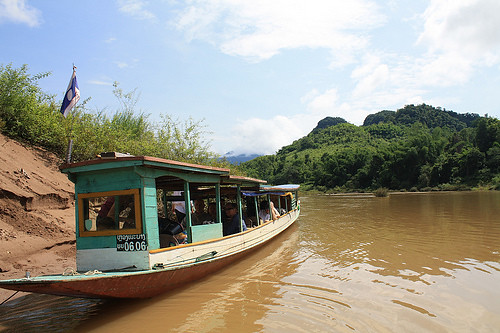
We began our river journey in Luang Prabang, one of Southeast Asia’s loveliest cities (more to come soon on this gem!). We boarded an old, wooden river boat that sits about eight passengers. The boat is a low-rider, with your head just peaking out above the river once you are aboard. Passengers sit two-by-two, giving everyone in the boat a good view for the scenic ride.

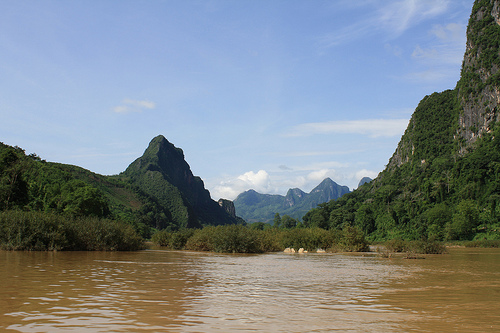
Our boat journey was a full day, 8-hour ride and along the way, we experienced some of the most dramatic scenery Laos is said to offer. Karst Mountains towered above us. Stilted, bamboo villages peaked out of jungled mountains. And the windy, beige ribbon they call the Mekong is the center of life.
Mekong River Scenery
The Mekong River seems to bring everyone together. We watched fisherman hide from the sun under bamboo hats while casting their nets in the muddy river. We saw herds of buffalo wading at the shoreline.

In the mist of the early morning, we watched in awe as a group of wild elephants gathered at the water’s edge to take a mud bath. And as the day unfolded, women gathered at the water’s edge to beat their laundry on the rocky shore aside a group of tangerine-clad novice monks taking an afternoon dip.

After experiencing some of the most spectacular river terrain my eyes have seen, we arrived at our final destination – the rustic, riverside village of Nong Kiau. From here we’d spend two days soaking up the spectacular scenery of the Mekong River.

Nong Kiau is a little settlement surrounded by vertical limestone mountains, dense forest and, of course, the Mekong River. There is a handful of bamboo bungalows tucked into the mountainside, where we made our home for a couple days.

With hardly any other sounds other than the songs of hundreds of birds and cicadas, we found this to be the single most peaceful place we’ve encountered in all of our journey.

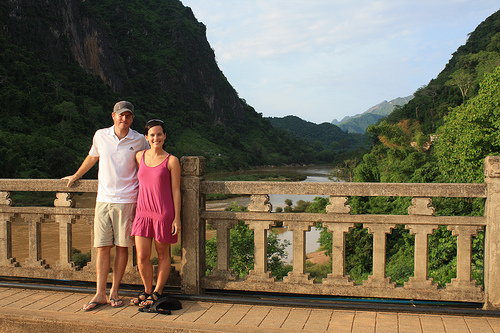
Nong Kiau, Laos
Here in serene Nong Kiau and on our scenic boat ride down the Mekong, we became even more enamored with the unspoiled gem of Laos.

Source: roundwego

Thursday, April 21, 2011

Trekking in Laos, the Forgotten Land

Leaving behind overwhelming and often brusque China, we were delighted to find pure, green, untouched Laos awaiting us.

Laos is a forgotten land. Like most, I didn’t know much about it before setting foot in the country. I knew it was at one time French occupied and that it usually earns a fleeting spot on many Southeast Asia travelers’ itineraries.

I could tell, however, within the first moments of entering the country that is was a special place that would soon earn a top spot on my list.

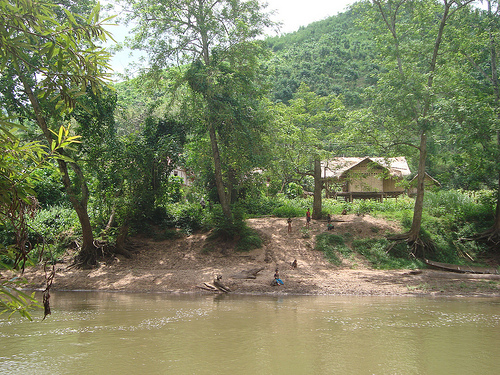
Bamboo Hut, Luang Nam Tha, Laos
On the drive from the border I was awestruck by the natural beauty of the country. Lush forests blanket rolling hills dotted with stilted bamboo huts. Thick jungles tower over muddy rivers where hill tribe villagers call home. Pools of water reflect a vibrant blue sky in endless fields of palm-fringed rice paddies.

Dubbed the “Jewel of the Mekong,” we were soon discovering Laos was in fact one of the great jewels of Asia. Our first stop in Luang Nam Tha confirmed the notion.

Luang Nam Tha is a small town based at the foothills of the jungle-covered mountains. It’s considered the most ethnically diverse area in all of Laos based on the countless number of ethnic minorities inhabiting the surrounding mountains.

The combination of a privileged geographic location and strong ties to its tribal heritage has helped Luang Nam Tha become the ecotourism destination of the country.

The whole town is set along one paved road. It has a nice selection of cafes and restaurants to choose from as well as a lively night market serving up some of Laos’ spicy favorites.

It was here we were introduced to the laid-back SE Asia vibe, discovered the gentle, innocent charm of the Laos people and celebrated the fact that some French traditions – strong coffee and fresh baguettes – still live on.

Village Scene, Luang Nam Tha, Laos
The real adventure of Luang Nam Tha, however, lies along the paths in the hills beyond. We embarked on a one day, guided trek through the mountains. Our day began on the back of tuk-tuk (the name given to rickshaws all over Asia due to the sound of their churning motors), which dropped us off at a village along a river.

From here we met our guide and other members of our group – an Israeli and two Japanese guys. We crossed the river in a small boat and were then lead straight up the mountain.

The trek was certainly intense and gave me new-found admiration for the soldiers who fought in similar topography, not far from here, in the Vietnam War. Words can’t describe how thick and dense these jungles are.

Vines, branches, prickly leaves, monster-size ants and all kinds of creepy crawlers cover your body the moment you enter the jungle. The heat is stifling. It’s so dense you don’t know where to plant your feet and when you do the mountains are so steep you find yourself falling down more than standing up.

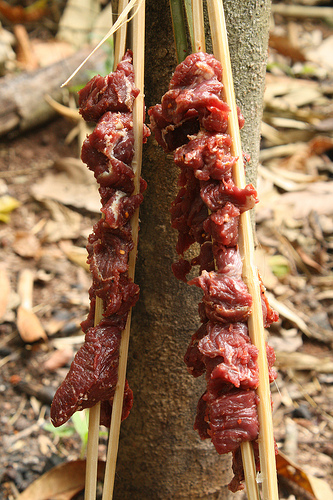
Buffalo Meat Lunch, Luang Nam Tha, Laos
At the top of the mountain it was time to reward ourselves. Here our guide prepared a feast. On the floor of the jungle, he built a fire to cook pieces of buffalo meat attached to bamboo sticks he’d picked up along the way.

On the dirt floor, he laid out a palm leaf to serve as our lunch table. He put out eggs and bean sprouts and spread dollops of green chili paste on the green palm leaf. When the meat was ready it was time to chow. He handed out what looked like tightly-wrapped presents, but what turned out to be sticky rice wrapped in banana leaves. We were told to open them up, use our hands and dig in. It was a true jungle experience.

With our tummies full of tough buffalo meat and spicy chilies, we made our way down the mountain to the river’s edge. Here we came upon a group of village children taking their daily bath in the river. As the sun began to set, we too dunked ourselves in for a swim. It was an idyllic way to end a memorable day in the pristine, feral jungle.

Source: roundwego
Recommended tour:
Trek Ban Nam Lai Village, Luang Namtha
Challenging Trek Nam Ha, Luang Namtha

Friday, April 8, 2011

Culture Rich Luang Prabang, Laos

Although Laos is an adventurer traveler’s dreams and is naturally stunning, one might be ready for a little luxury and culture.

That’s just what I needed, so after spending a day kayaking, trekking and riding elephants, I decided to let my travel companion train and play with elephants on her own while I spent a day exploring the culture and beauty of Luang Prabang as well as enjoy its tranquility.

Luang Prabang is a Unesco World Heritage Site; therefore there is a wonderful absence of the usual truck and bus congestion. This makes shopping and dining (loads of wonderful shops and restaurants) more enjoyable for all.

Luang Prabang, Laos
There are a number of Buddhist temples worthy of much more than a cursory glance. You will see a number of saffron-robed monks around the temples and city, most notably the Tak Bat. Each morning, the monks of Luang Prabang quietly pad down the cobblestone streets gathering rice and alms from locals and tourists alike – a must see if you can get up early enough.

Luang Prabang, once the seat of the Laotian Monarchy, boasts its own Royal Palace, which is now a museum. It is diverting to see how the royals lived, plus is inexpensive and is a quick tour – all good in my book. You can also check out interesting gifts from foreign dignitaries and some pretty sweet rides in the garage!

Just across from the palace is the trailhead to Phou Si Hill, a charming walk to the top (at just 325 feet) is dotted with shrines and temples, as well as some fowl and lovely foliage.

You won’t even notice how sweaty you have become once you see the breathtaking views of the Mekong and green hills that surround you. Wandering around, you will find temples, caves and numerous Buddha statues, even Buddha’s footprint. As there are many routes to get up and down, I recommend retreating down the back where you will come near a monastery.

I ended the day, tiring in its own rite, with a $5 Lao massage (similar to the Thai massage) and a cold drink on the main drag, giving me energy for the night market later.

Source: butofcoursetravel

Wednesday, February 9, 2011

Travel Tips and advice from Active Travel Laos

After years of war and isolation, Southeast Asia’s most pristine environment, intact cultures and quite possibly the most chilled – out people on earth mean destination Laos is fast earning cult status among travelers. Active Travel Laos (http://www.activetravellaos.com ) shows some travel tips and advice in Laos.
Vientiane, LaosVientiane, Laos

Laos is a country that offers plenty of challenging terrain, interesting sites and activities for the adventurous. You can kayak or go boating down the Mekong, trek through jungles atop an elephant, go exploring and even rock-climbing in limestone caves, hike mountains in search of remote and ancient temple ruins or camp out in wildlife conservation parks.

Below on this Laos Country Guide is some useful travel information for visitors contemplating a trip to Laos, including suggestions on where and when to go, visa requirements, money used, information about Laos food and drink as well as a handy Travellers' Dos and Don'ts list.

Traveller Dos and Don'ts

- Do dress modestly when entering temples, museums, official buildings and government offices; no shorts or sleeveless shirts, tank tops or beach wear. Shorts that cover the thighs are acceptable everywhere else. Be clean and neat in appearance whenever possible.

- Do like the locals and keep your sense of time flexible. Expecting punctuality will often lead to frustration.

- Do remove shoes when entering temples and homes (it is convenient to wear slip-ons or sandals).

- Don't point your feet towards people or Buddha images. When sitting in a temple, keep legs together and to the side in a mermaid position.

- Do consider leaving a small donation when visiting temples.

- Don't take pictures posing with Buddha images, handle, climb or sit on them.

- Don't, if you are a woman, touch monks, hand them objects, sit with or talk to them outside of temples. Any offerings need to pass through the hands of a man first.

- Do ask permission before taking pictures of people, particularly in villages outside the cities where the people may have superstitions against being photographed.

- Don't touch people or children on their heads.

- Don't lose your temper in public - speaking loudly and angrily is often counterproductive.

- Don't engage in public displays of affection.

- Do greet someone who is greeting you - by nop, handshake or a polite bow and smile - but don't offer a kiss!

- Do respect the Laos' interpersonal space - there is little physical contact or closeness between individuals who are not family.

- Don't be surprised if someone goes right past you to get to something first - Laos generally do not queue up for anything.

- Do bargain for goods in markets and shops (except where there are fixed prices) but do so with a good attitude and smile. Prices are generally not inordinately high to begin with as they may be in other Asian cities.
Luang Prabang, LaosLuang Prabang, Laos

Visas and Passports

Passports

Passport with at least six months remaining validity required by everyone who enters Laos.

Visas

Required by all nationals from the UK, Australia, Canada, USA and EU countries.

Visa requirements are subject to change and you should check with your embassy to check the latest visa requirements.

Visas on arrival are for 30 days for most nationalities and this can be extended a max of two times for up to 30 days each time.

The Lao Ministry of Foreign Affairs states that visas can be issued upon arrival in Laos to tourists at the following ports of entry: Wattay Airport in Vientiane; Pakse and Luang Prabang Airports; Friendship Bridges in Vientiane and Savannakhet; and land-border crossings at Boten, Huay Xai and Chong Mek.

Visa Cost

Visa cost ranges from $20 (China) to $42 (Canada). Sweden is $31, $35 for the USA, UK and most of Europe, $40 for India, Pakistan and Sri Lanka and $30 for Australia. The full list is on display at the Visa Application window.

Validity

All visas are issued for single entry and must be used within two months of date of issue.

Applications to: Consulate (or consular section at embassy) or an officially recognized tour operator. A visa valid for Laos can also be obtained from travel agencies in Bangkok (Thailand) or on arrival.

Active Travel Laos is member of ACTIVETRAVEL ASIA offers a wide selection of Laos adventure tours, including hiking and trekking, kayaking, biking, motorcycling, overland touring and family travel packages. The travel packages and custom itineraries will take travelers through exotic destinations to really experience the culture, history and nature of Laos.
Thursday, October 28, 2010

Why travel Laos and tips

Refer to Telegraph, in the recent time, the violence and killings on the streets of Bangkok - coupled with a hardening of Foreign Office advice not to travel there – will have horrified many holidaymakers considering a trip to Thailand, traditionally the most popular destination in South-East Asia and a country that sells itself as the “Land of Smiles”.

However, travellers wanting to head to this part of the world should not be deterred: the region’s newer, less well explored destinations – Vietnam, Cambodia and Laos – have an immense amount to offer – including breathtaking landscapes, timeless rivers (not least the Mekong), world-class ruins – and diverse minority tribes.

Why go Laos

Landlocked Laos has a relaxed pace of life and indifference to tourism that make it an idyllic escape. Luang Prabang is one of the most beguiling cities in Asia, with Unesco World Heritage status and faded French charm. Start the day watching alms-collecting monks file down the streets at dawn, and then visit a glittering Buddhist temple. At sunset, drink a Beer Lao on the banks of the Mekong before shopping for local crafts at the lantern-lit night market.

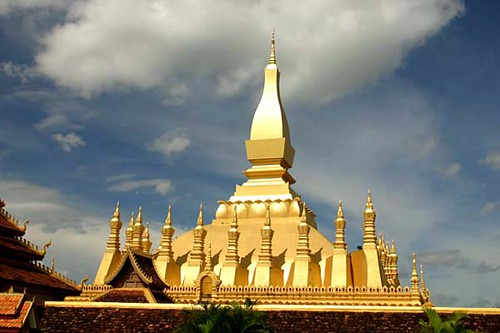
Travellers seeking the comforts of boutique hotels will find them here and in the country’s capital, Vientiane, alongside colonial villas, pleasant boulevards and Laos’s most important golden stupa, the 150ft-tall Pha That Luang.

Vientiane, LaosVientiane, Laos

To get off the beaten track, take a boat along the bucolic Nam Ou river from Luang Prabang, and drift past caves filled with images of the Buddha and dramatic karst scenery, ending up in sleepy village backwaters. Accommodation is rustic, but nothing beats swinging in a hammock and letting time pass Lao-style.

Ecotourism is blossoming at Luang Nam Tha in the north, where it is possible to walk to the villages of the animist Akha people. Alternatively, head south to the Mekong islands of Si Phan Don, home to fishing villages, waterfalls and rare Irrawaddy dolphins.

Tips: Lao food is relatively unknown, but there are some tasty dishes. Try some jaew, chilli dipping paste for balls of sticky rice, and laab, a fresh, spicy, minced-meat salad, tossed with mint and coriander.
ActiveTravel Laoss (+84-43-633-9576; www.activetravellaos.com) can arrange tailor-made trips to northern and southern Laos. The 12-day Undiscovered Laos and Cambodia includes two nights in Si Phan Don.

Contact Lao National Tourism Administration (www.ecotourismlaos.com) for further information