I am, it's fair to say, in the middle of nowhere. This is the Tatai River, east of Koh Kong, in the southern reaches of Cambodia's Cardamom Mountains. Halfway between Bangkok and Phnom Penh, this is a pristine area of rainforest and coastal mangroves that barely features on the tourist trail.
Thursday, June 2, 2011
Green stamp on jungle style
I am, it's fair to say, in the middle of nowhere. This is the Tatai River, east of Koh Kong, in the southern reaches of Cambodia's Cardamom Mountains. Halfway between Bangkok and Phnom Penh, this is a pristine area of rainforest and coastal mangroves that barely features on the tourist trail.
Friday, March 11, 2011
Travel to Cambodia, an Exotic Place for Adventure in Southeast Asia
Visit to Angkor Wat Recharges the Spirit
Waking up before dawn in Saigon, Vietnam, today I would venture into Cambodia. Cambodia was a land I had heard so much about and had only dreamed of ever getting to visit.
Crossing into Cambodia was like entering a different world, though. Immediately things were not like in Vietnam. The bus ventured on for another seven hours to Siem Riep, the small but charming town that accommodates visitors to the magnificent and awe-inspiring Angkor Wat.
Angkor Wat
I had heard so much about Angkor Wat over the years of my life that is seemed more like a place in myth rather than in reality. I wanted to see it for myself to determine whether all the things I had heard about its magnificence were indeed true.
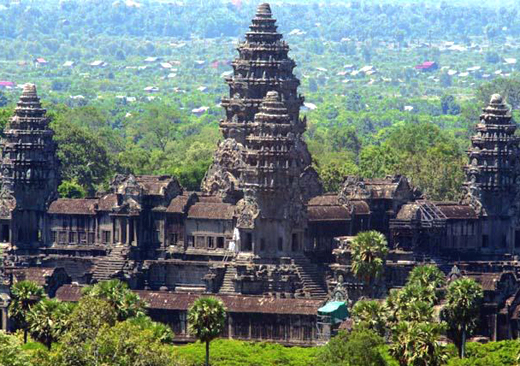
Angkor Wat temple
Angkor was actually more than just temples. As in any other city, there were houses, shops, medical facilities, and government offices. But only temples were considered important enough to be made of stone. All the other structures were made of wood and have long since ceased to exist. Only the temples, and a library building, remain today.
The spiritual feeling that the visitor to the temple gets is indescribable. I am not a religious person, but I cannot deny that I felt such an intense measure of peace and well being there that I sensed some kind of divine presence. It was so strong that I did not want to leave the temple. It really does capture your spirit and takes your breath away.
There is something magical about some places on earth, and Angkor Wat is certainly one of them.
My words are futile, worthless really. For what words can give life to such a powerful creation, something that is really larger than life itself, and certainly beyond words?
After such a great, uplifting experience exploring Angkor Wat and the other temples, the tour group decided they wanted to explore a floating village on a small river flowing from the gigantic Tonle Sap, Southeast Asia’s largest freshwater lake.
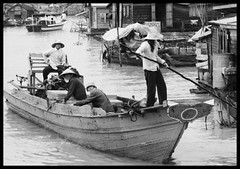
A floating village on the Tonle Sap River
It was yet another interesting adventure in this exotic land. None of the structures that comprise the village – houses, shops, schools, and even a library – was built on land. Every facility was actually a boat that constantly floated on the river. The fluidity and detachment of this village stood in marked contrast to the seeming permanence of the temples of Angkor.
Source: hubpages.com
Wednesday, February 16, 2011
Travel Cambodia by Photos
One great thing about photographing Angkor from the West at sunrise is that the structure itself is silhouetted. That can be important as there is nearly perpetual restoration work on the temple itself so there are always some unfortunately colored green tarps somewhere on the towers that are hard to hide and painful to remove in Photoshop. But of course with a silhouette shot it is much easier to ignore them.

Since much of the source of power for the Khmer empire was their irrigation system—allowing them to have two or three rice crops per year, freeing up citizens for the army and temple building—and the temples are in many cases built to help glorify those efforts it is always special to see them in their natural condition with the various ponds and reflecting pools clean and full.
Cambodia Today
But the legacies of decades of war are still visible. One of the most horrific was the seeding of the country with millions of landmines from the literally dozens of different armed groups that were involved in the string of conflicts that raged through Southeast Asia in the 50s, 60s and 70s.
Temples off the Beaten Path
It is hard to believe when you first see the mammoth stone edifices but the Khmer never invented the arch, so all of the temples are made of stacks of large blocks of rock using either lintels or corbelling to create interior space.
More incredible is that they did not use any type of mortar so the structures were all “dry-stacked” together, in many cases so carefully hewn that a piece of paper would not slide between blocks each weighing many tons—and hauled as far as 60 miles from where they were originally quarried.


Stairs in this temple, like many, were steep on purpose as the “stairway to heaven” was supposed to be difficult. Today many of them are protected with wooden overlays which will preserve their rock faces and make climbing much easier for visitors.
Beyond Angkor—Rolous
We always take a day to venture a little further afield and visit both the Rolous Group of temples—the pre-Angkorian Khmer temples—and the surrounding towns, monasteries and markets.
Source: http://www.cardinalphoto.com
By: David Cardinal


