Monday, August 18, 2014

The Untouched Gems of Northwest Vietnam

By Shivya
For many travelers, Vietnam is the cities of Ho Chi Minh & Hanoi, and the tours that take you around the area. While some of these are pretty and tourist-friendly, most of these are fabricated versions of Vietnam’s real beauty and people. We managed to ditch most of these must-tick boxes in our Vietnam itinerary to explore the less-treaded North Western highlands of the country.

Mai Chau

Biking Mai Chau
Mist in Mai Chau
No Lonely Planet overview can prepare you for the gorgeous, mist-covered mountains that greet you as you enter the village of Ben Lac, nor for the hospitality of its White Thai folks. There are Mai Chau trekking tours from Hanoi that take you there.

Biking on the hill slopes of Mai Chau
We stayed with a couple in a traditional stilt house, and were flattered by their openness, despite the language barrier, and by the lady’s (vegetarian, as requested by me) cooking. We spent a surreal morning Mai Chau biking on the slopes of the village, passing stilt houses and open rivers & streams, into the heart of the mountains which never for a second failed to enchant us. Time didn’t permit us to explore other surrounding villages or trek up one of the mountains, but it sure gave us a reason to visit again.

Trekking Mai Chau 2
A traditional house on stilts in the Ban Lac village of White Thai tribes

From Mai Chau to Dien Bein Phu, via Moc Chau and Son La

If you haven’t been to Vietnam, the names will sound very strange; they might sound strange even if you’ve been to Ho Chi Minh and Hanoi. Let’s say these are some of the most offbeat routes in North West Vietnam, and that is a huge blessing. If Mai Chau was beautiful, I am at a loss of words to describe what we saw next. The journey from Mai Chau to Dien Bien Phu is like entering a post card and never getting out. The Tonkinese Alps (rightfully called) are as stunning as they are imposing, and we traveled for miles without taking our eyes off them. The thrill was heightened by our insistence to travel in local buses with various tribes of people who board and alight at obscure stops, many of them dressed in colorful ethnic costumes and carrying their babies in kangaroo-like sacks.

Dien Bien Phu 1
The sky en route to Dien Bien Phu
Dien Bien Phu 2
The sun decorating the mountain skyline
From Dien Bien Phu to Lai Chau, via Muong Lay

Dien Bien Phu is a sleepy town, significant in French history in relation to the Vietnam war, and made just an overnight stopover for us.

Can you close your eyes and picture the backdrop in Pirates of the Caribbean? In this journey, you can see that backdrop with your eyes wide open, stunned in fact, because it’s hard to imagine that such beauty exists in such a remote part of Vietnam. If you ask me, you haven’t seen Vietnam if you haven’t done this route. Referred to by locals as the “Halong on Land”, the scenery is magical, with slopes of the lush Tonkinese Alps enclosing a river that runs for miles (possibly the Mekong River).

Muong Lay, the old Lai Chau, was a thriving community until the river flooded and submerged the town a few years ago. A new river-side mountain-side township is now under construction and promises to be an unparalleled attraction if discovered by enough travelers. Between Muong Lay and Lai Chau, I saw the most beautiful mountain landscape I’ve ever seen, and I’ve seen my fair share of hills and valleys in Asia. Lai Chau is just another sleepy town, just barely alive to break the journey for the night, onward to the touristy valley of Sapa.

The beauty is so virgin that we couldn’t get ourselves to capture it in photographs, for fear of contaminating and misconstruing its purity. Apologies for not sharing pictures on this part; no pictures could do justice.

Thursday, August 14, 2014

Trekking to discover a surprising life in Sapa

By Monica S.
I'm starting this blog post with a quote I found in the "South East Asia Backpacker," a monthly magazine full of inspiring stories written by people who are either traveling through or have moved to South East Asia. I find it to be quite appropriate for the story I'm about to tell. Firstly, I knew absolutely nothing about the hill tribes living in the north of Vietnam before I took a trekking Sapa . Secondly, had I not met them in person, I would not be inclined as passionately as I am to do something to help them. And lastly, it made me aware of how fortunate I am to be able to travel. So many people are "vegetating" in their own corner of the earth and could only dream of traveling, but are too poor to do so. I used to be one of these people up until not long ago. Coming from a developing country myself, I've experienced poverty and lack of mobility. But I kept dreaming. And I am now so grateful to have fulfilled some of those dreams.

Trekking Sapa 1
We really wanted to do a trek through northern Laos and stay with one of the hill tribes there, but we didn't have enough time. When we got to Vietnam, we were happy to find out that they have similar tribes living in the mountains in the northern part of the country. We were able to arrange going up there, hiking around and staying overnight with a local family. Despite the cold weather that took me unprepared and reminded me of San Francisco, I absolutely loved this trip and would've gladly stayed there longer, had we had more time.

Trekking Sapa 2

The Black Hmong villages in northern Vietnam are located very close to the border with China. Apparently, many of them migrated centuries ago from China and parts of Mongolia. To get there we took an overnight train from Hanoi to Lao Cao, a sad and grim, communist-looking town on the border with China. It reminded me a lot of childhood winters in Communist Romania. We arrived in Lao Cao at 6am and were shuttled in a packed minivan over a windy mountain road for about an hour until we reached the town of Sapa. Sapa is like a mountain resort, and the starting point for a lot of activities, such as hiking Fansipan, the highest mountain in Vietnam. It also boasts a full-on North Face fake store. Everything in the store is a copy and it costs about $20. I haven't been inside, but some people we met said the clothes looked the same quality as original North Face clothes.

Our guide was waiting for us in Sapa and after we ate some breakfast we started the trek. During this time of the year, it is very cold and foggy, so you can't see much. The rice paddies are also not in full swing, so they don't boast the lush green you'd expect. Also, because of the heavy rains, the roads turn into a deep, slippery mud. Our hike was basically walking uphill or downhill through intense mud. Downhill was quite treacherous, at times it felt like hiking down a slip-and-slide.

Trekking Sapa 3

The girl on the right is our guide. The one on the left is one of the many women that followed us during the entire hike. They ask us a million questions:  where you're from, how old are you, how many siblings you have, if you're married and have babies, if you have a boyfriend, etc. When you look like you're about to lose balance and fall, they're right there, holding your hand and showing you where to step next. Your heart melts and you think you just made a new friend. You are impressed at how friendly and helpful the people are.

The tribes distinguish themselves mostly through the type of clothes and hats women wear. Zay women wear red hats and embroidered pants, while Hmong women wear embroidered skirts and colorful head scarves. After harassing Daniel for the longest time possible, the two ladies called mission accomplished. He succumbed and bought a pack of postcards for 5 USD. Mind you, in Vietnam, $5 is the equivalent of a day's wages.

Trekking Sapa 4

The landscape, shrouded in fog the entire time, was magic. Tons of suspension bridges everywhere, but we didn't get to cross any. For every suspension bridge there was a new sturdier bridge built nearby. And some suspension bridges were really shabby, missing entire sections.
Main street and grocery store in a Hmong village. I can't begin to describe how poor these people are. The only other place I've seen similar levels of poverty is Bolivia. Despite that, people seemed happy. It seemed normal. It felt like the simple kind of life that humans have led for centuries in these parts of the world.

Hiking through mud along rice paddies. I felt really grateful for having my sturdy comfy hiking boots. This was yet another extreme test for how awesome they are.

Trekking Sapa 4

Our wonderful guide and her 10-month old baby. The cutest, smiliest, happiest baby in the world! Our guide was 19 years old and she had been married for 3 years already. Her husband, a year younger than her, takes care of the baby in the mornings while she's guiding tourists. At noon she gets back home and brings the tourists with her, to show them where she lives. She does this, so she can breast-feed the baby, strap him on her back and then continue the hike in the afternoon. At the end of the hike, she cooks for all of us and after dinner her husband comes to pick the two of them up with the motorbike. For the late night ride, the 10-month old baby gets strapped to the front of the mommy, so it can be sandwiched between its parents on the motorbike and protected from the cold. For guiding a group of tourists like this, she gets paid 5 USD/day. She works 4 days a week. Her husband is currently building their house, where she invited us. The house consists of a big room, walls made of bamboo leaves, no bathroom, no kitchen. Just a hole in the ground with a fire burning above it, a bed in a corner, a few clothes hanging on a rope and a few plastic stools.

Trekking Sapa 5

The magic bridge - a photographer's dream. You probably can't even tell it's a bridge. It's suspended really high above rice fields, it's very narrow (a car can't fit), doesn't have railings and has zero visibility. We didn't see anyone walk on it, so we don't really know what its purpose was. 

Trekking Sapa 6

One of my top favorite photos of this trip so far. I guess by the end I'll have a solid collection of Anne jumping shots. Anne tried to do a few shots of me jumping, but apparently I can't jump for a photo for the life of me. I look goofy in all of them.

Our guide's English was excellent, by far better than that of many people we've met in Hanoi or entire Vietnam for that matter. I asked her how she managed to speak so well and she said she started out following tourists and trying to sell them things. She would engage in conversations with them and pick up words really fast. Some tourists really liked her and wanted her to be their guide. The word got out that she's a likable girl with good command of English, so the trekking company hired her. The frequency of her gigs is solely based on feedback and reviews from tourists.

Trekking Sapa 7

The kitchen of the homestay where we slept. It was so cold inside the house that you could see your own breath. A few of our group of 9 gathered around the fire. The pot in the middle is boiling food for the pigs: a mix of cornmeal and leftover scraps.

Trekking Sapa 8

Food in northern Vietnam is plain and some of the dishes remind me of Chinese food, maybe because they are so close to the border with China. All the food is stir-fried in a wok. We got stir-fried cabbage, chicken with bok choi and vegetables, steamed rice, spring rolls and fried tofu. The family also served us rice wine, which tastes more like vodka than sake.

Trekking Sapa 9

The next day the visibility was a bit better, so we could see the beautiful landscapes hiding behind the thick fog on the previous day. 

Trekking Sapa 10

There was no bridge for this river, so we crossed the water on two metal beams, suspended across two rocks. We didn't want to do it at first, but it was actually easier than we thought. I love the ingenuity of the people here. There's always a solution for everything, even if it's not the most elegant, safe or logical solution. Things seem to always work out, somehow.

Trekking Sapa 11

The woman right next to me is the one who befriended me during the hike. She told me she is 36 years old and already has several children. I told her I am 31 years old and she couldn't believe me. Again, another resemblance to women we met in Peru and Bolivia: hard physical labor, marriage and kids from an early age make these women mature faster and look older than they actually are. In the mountains of Peru and Vietnam, villagers look almost 20 years older than they are. 

Tuesday, August 12, 2014

Kayaking Halong Bay - Secret Lakes and Fish Farms

By Kit and Melenie
Today was to be a momentous day - the very first day to ever embark on an 'adventure' holiday - well, as adventurous as a 2 day kayaking Halong Bay on flat water can be considered. Yes, we were off to Halong Bay, Vietnam's most famous natural attraction, to explore underwater caves, hidden lagoons and secluded beaches, all while surrounded by spectacular water-submerged karst splendors. Karst, for those uneducated individual out there, since everybody knows what karst is, is a fancy name for big gray moutains of limestone that have lots of caverns, streams and sinkholes running through them.

Kayaking Halong Bay 1
Kayaking Halong Bay
But first off, we had to enjoy a completely unscenic 4 hour drive to Haiphong, an industrial city that also served as the port to the Halong bay area. We then hopped onto a ferry that whizzed us across to Cat Ba Island. 5.5 hours on clock so far, and we disembark to discover that we still had to catch one more boat. But this boat was cool - a beautiful 50 seater wooden carved barge with a passenger list of 2 - just us.

We started off drifting slowly amongst the huge karst islands. There is something magical about those islands - perhaps its the complete silence, and ambiance that is non existent back home. Each island had its distinct shape, which gave us hours of 'what animal does that look like' games. Many had large low overhanging cliffs, which meant we could glide underneath those rocks, pretending we were in underground caves.

Kayaking Halong 2
Each island had its distict shape
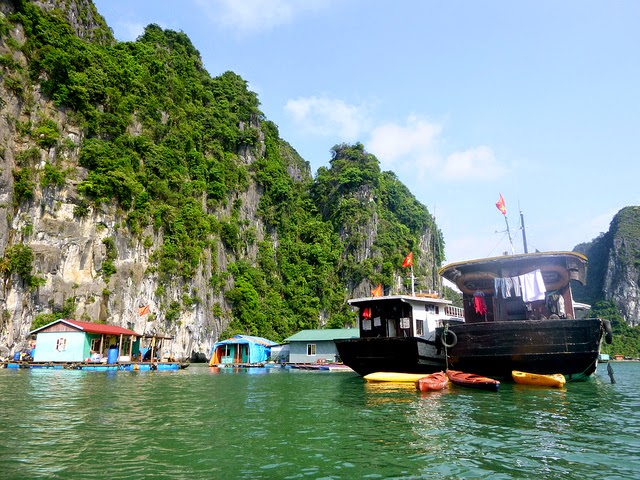
After an hour of paddling we came to our first stop - a floating fish farm. Out here, there are numerous of these - little floating piers about the size of 6 car park spaces, on which the farmers have built a house. They live out here, on their tiny little man-made island, rearing fish, together with their families. We saw little kids, and even dogs living on the floating farms. 
Kayaking Halong 3
A Fish Farm
Next up we went to a 'secret lake'. Not quite as secret as it was meant to be though, since there were two other boats there when we arrived. What made this place secret is that you can only access it at low tide, when the water level drops below a mountain ridge revealing a very short little cave that lets you past. On the other side awaits a lake, secluded from the outside world by the surrounding monoliths. 

We then headed over to a little beach for some paddling and sun baking. The water here is reasonably clean, but smells and tastes fishy - I guess that's why they have so many fish farms around. So after a quick dip, we emerged from the water exuding odours akin to the local fish market. 

The next day we headed out in the kayaks for a second day of exploring. By now, we were kind of sick of Karst scenery, so our guide said he would take us underground caving. Alas, when we arrived at the cave, the tide was too high, and hence we were blocked from caving. But not to fear - the back up plan was just us fun - though a heck of a lot more tiring. Duc took us out into the open ocean - across big waves (I'd like to say 2 meter waves, but they probably weren't). Just when we were at the point of exhaustion, we pulled into a quiet little bay - the home of a private pristine little beach. Now this is the kind of adventuring we love - secret little spots at every corner!! This was a gorgeous little place, so we camped out here for a few hours, just enjoying the solitude and a blue blue waters.
Kayaking Halong 4
Emerging from the"Secret Lake"
We did a bit more kayaking afterwards, seeing a few more sights, before heading back sadly for the trip back to Hanoi. Our boat back to the main island this time was not quiet as elaborate as the one we had arrived on. But a heck of a lot cooler. It was a little diesel tug boat made of random pieces of wood shoved together. We rode sitting on the back on some plank, with the engine puffing right below us. It was a fun experience - felt very 'back to grass roots'.

So ended our Halong Bay tour. We're glad we decided to the do the kayak trek, because although the scenery of Halong is beautiful, its much more of a place to be 'experienced' that to be gawked at.

Monday, August 11, 2014

Things to do in Sapa


Just a cushy overnight train journey (350km North of Hanoi) towards the Chinese border, lies the mountainous market town of Sapa. Cooler temperatures, extravagantly dressed hill tribe folks and a French colonial flavour make you feel like you’ve stepped into a different world. The little town is charming in it’s own right, with it’s quaint little streets, coffee shops and bustling markets, but it is best used as the starting point for adventures into the surrounding hills and valleys.

Trekking Sapa Vietnam 1

Trekking amidst misty mountains and steeped rice terraces to visit traditional hill-tribe villages is where the real magic of Sapa can be found. And, although the area is now very accustomed to visits from tourists, you’ll still experience a fascinating way of life and witness a different side to Vietnam. (You’ll even come away with a fetching cushion cover you never knew you needed!)

For longer trekking Sapa, (two or three days) it’s possible to arrange home stays with the Black H’mong, Red Dzao and Dzay ethnic minorities, where you’ll be welcomed into their homes as part of the family – ladle upon ladle of delicious homemade food and lashings of potent local moonshine ‘Xeo’ guaranteed! Waking up to the fresh mountain air and the beautiful scenery all around is an experience that you won’t forget.

Trekking Sapa Vietnam 2

Further day trips from Sapa include visits to the traditional markets, such as Bac Ha Weekend Market and Muong Hum Market. Mingle with the locals as they trade homemade goods, haggle for some unique souvenirs and try some local delicacies. For a unique cultural experience, don’t miss the Saturday night ‘Love Market’ in Sapa where local hill tribes congregate from villages all around to find their perfect match.

If you’re feeling really adventurous you can climb (and hopefully summit) the highest mountain in Vietnam, ‘Fansipan.’ (3143 m) Climb through pine forest and bamboo thicket to reach the summit and be rewarded with amazing panoramic views over Vietnam and North to China and Yunnan province.
Source:Southeastasiabackpacker

Sunday, August 10, 2014

Impressive trekking Northern Vietnam

By Lloydalex
With the aid of Max the Australian raconteur and Kangaroo Cafe owner and tour organizer, we found our way onto the train. Whilst it's no Orient Express, the 4 berth cabin is a much better way to travel than bus (I'm sure our friends in the Philippines understand what I mean). Tucked up in your little bunk it's not too difficult to get to sleep. Of course you wake up a few times through the night but on the whole, a good rest. Before I knew it, Alexandra was waking me from a deep sleep to tell me that the conductor had been knocking on the door... We have arrived... well almost, wait around for an hour and catch a minibus to Sapa, some 30 kilometers south of the China border... How exotic. 

Trekking Sapa, 1
Trekking Sapa, Vietnam

Not too long ago we had the privelege of visiting the spectacular rice terraces in Banaue and Batad with some good friends in the Philippines. The weather was perfect. So naturally, we are inclined to compare one place with another... Well the weather was also perfect in Sapa, perfect for growing rice that is. You need a lot of water to grow rice.

Trekking Sapa 2

Much effort was expended in just trying to stay upright on the steep slippery trail and along the edge of the rice terraces. Fortunately we were accompanied by sure footed H'mong ladies including one who is due to give birth in 2 weeks, always ready to extend a helping hand. We walked through valleys and over hills, through lush bamboo forests infested with leeches, luckily our guide saved Alex from one. On the second day the weather lifted a little and we did get to see more of the terraces. And like the Philippines, they too were spectacular.

Trekking Sapa 3

Our little 2 day trekking Sapa tour took us from the tourist town of Sapa through the villages of Linh Ho, Lao Chai, Ta Van and Giang Ta. Along the way we encountered several different tribes including various H'mong (pronounced "mong"), Dzay, Dzao and others. What we didn't see in terms of views were made up for by the time spent with the hill tribe people, especially our guide.

Su is a humble lady with a warm smiling face that lights up the mountain. She never had the opportunity to go to school and says she cannot read. Happily the government does now provide free primary age schooling which her children attend.