1. We’re already out of date.
After more than a week in $5-a-night hostels in Peru, Caitlin Childs was looking forward to a hot shower and a comfortable bed. But when she got to the Hotel Paracas, there was no hot shower, no bed – and no hotel. “It had been leveled in an earthquake the year before,” says Childs, a graphic designer and frequent traveler. It turned out her Footprint Peru Handbook – the latest edition – had been published a year and a half before her July 2008 trip.
Even without earthquakes, much of the information covered by guidebooks changes too fast for book publishers to keep up. Restaurants close, quaint markets lose their cachet, and trains change their schedules. If it’s essential to your trip, make a phone call before you go, says Peggy Goldman, the president of Friendly Planet Travel, a tour operator. Never rely on a guidebook for key information like whether you’ll need a visa to enter a country and how much it will cost, or what vaccinations you might need, Goldman says, because those facts can change rapidly. Although the guidebook’s web site may have more up-to-date information, travelers should still check with the consulate and look for CDC alerts for the latest information.
2. No news is bad news.
There’s simply not space in most guidebooks to include negative reviews – so a hotel or restaurant that isn’t in the book might not have made the cut for a reason, says Thomas Kohnstamm, a former Lonely Planet guidebook writer and the author of the memoir, “Do Travel Writers Go to Hell?” Guidebooks are also trying not just to inform but to sell potential travelers on the idea of a particular destination, he says. The end result: Every beach is beautiful, and the people of every country are “some of the nicest people in the world.” “It’s supposed to be an unvarnished take on places but you have to be pretty PC about everything,” Kohnstamm says.
It’s true that space is limited, so if something isn’t in the book, “there may be a reason,” says Ensley Eikenburg, the associate publisher of Frommer’s travel guides. The exception: “There are certain iconic places that can be overrated, and that’s something we encourage our writers to say,” she says.
3. We haven’t actually been there.
It’s called a “desk update": Writers use the phone, the Internet, stories from other travelers and even old-fashioned books to research a destination, but they never actually go there. The practice is common throughout the travel industry, Kohnstamm says. And with tight budgets, some publishers simply never ask how writers are getting their information.
Eikenburg, of Frommer’s, admits that the company does desk updates, but only on a few titles that cover multiple countries, while Lonely Planet’s Americas publisher, Brice Gosnell, says that the company’s contracts with writers always require travel to the location they’re covering.
4. We’re relying on you to catch our mistakes.
There’s essentially no fact-checking process for most guidebooks, Kohnstamm says. “They might do a random check, but mainly they’re trying to rely on the writer” to get things right, he says. (Lonely Planet and Frommer’s say fact-checking is the writer’s responsibility.) In practice, and with the prevalence of the “desk update” (see No. 2), that may mean waiting for readers to point out errors or out-of-date information. Jeffrey Ward, the founder of Savvy Navigator Tours, says he once wrote to Fodor’s to let them know that the index to their South Africa guide was from a previous edition, making it very difficult to quickly look up restaurants or sites while out walking around. Ward says the company sent him a free copy of a corrected book within a couple of months.
5. That “easy” hike is only easy for experts.
In 2007, a 32-year old hiker died taking what a guidebook had described as the “easy way” up Tryfan, a 3,000-foot mountain in Wales. “The definition of ‘easy’ is relative depending upon your experience, your physical ability, your footwear, clothing and kit, and your party,” explains Chris Lloyd, a spokesman for the local Ogwen Valley Mountain Rescue Organization. Death by hiking is fortunately uncommon, but Brian King, the publisher of guidebooks for the Appalachian Trail Conservancy, says his organization frequently hears complaints from less-experienced hikers who feel the books make scrambling over boulders sound like an easy day’s stroll. “We could probably do a better job of accommodating the day hiker,” King says.
6. We ruined that secluded spot we mentioned.
Brian Ghidinelli thought he and his wife were the only tourists in Old Hanoi’s winding streets – until they walked into a Lonely-Planet-recommended restaurant, which was packed with other travelers, some with their own Lonely Planet Vietnam guides on their tables. “While we ate, several more pairs walked in with guidebook in hand,” Ghidinelli, an entrepreneur and experienced traveler, says. Accidentally walking into a tourist trap can have financial consequences, too. In Ghidinelli’s experience, hotels and restaurants recommended by the guidebook tended to cost 25% or 30% more than those that didn’t cater to tourists.
7. We’re terrified of your smartphone.
Ten years ago, guidebooks to popular destinations like Walt Disney World or Paris were common on the New York Times best-sellers list, says Michael Norris, a senior analyst for Simba Information, a market research firm that covers publishing and media. These days, the physical books just don’t sell as well as they used to, in part because so much information is now available for free online – TripAdvisor, anyone? – and can be accessed on the spot with a GPS-equipped phone.
8. Going to Estonia? We don’t really care.
Guidebook writers sent to less well-traveled destinations are often hindered by tiny budgets, Kohnstamm says, explaining that books about popular destinations command the majority of the companies' resources. “The rest get sort of short shrift,” he says. Other publishers see it differently. Frommer’s doesn’t spend more on the more popular guides either, Eikenburg says. “If one of our customers buys our guide to Panama and it’s not accurate, then we’ve lost that customer to the competition when they go out and buy an Italy guide or an Alaska guide,” she says.
9. We’re tourists too.
Guidebooks can’t always be trusted for “insider” tips on what the locals eat, how they behave or what the cultural norms are in a country, says Bryan Schmidt, who has traveled to six countries on four continents over the last ten years. Guidebooks for Brazil, for example, will recommend places to get “authentic” feijoada, a traditional meat and bean stew – but Schmidt, whose wife is Brazilian, says even those meals are designed for tourists. Of course, some may see that as a blessing: The truly authentic dish involves “a lot of pig ears and pig snouts,” Schmidt says.
“It’s possible to overcome the challenge of not being from a place, but it just takes a lot of time,” says James Kaiser, the author of several independent guidebooks to national parks. Kaiser says he likes to spend about two years doing research so he can get to know locals and see how a place changes over time. Of course, even locals can make mistakes. Kaiser grew up near Acadia National Park in Maine, but his first guide to the area included a recommendation of a picnic spot for families that he came to regret. “Nude bathing was not uncommon,” Kaiser says. “I learned the hard way to triple-check my information.”
10. Don’t take all of our advice.
Some travelers feel guidebooks encourage a frenzied, see-it-all approach to tourism. “I have a really good friend who’s a lawyer, and she prepares for a trip the same way she prepares for a murder trial,” says Friendly Planet Travel’s Goldman. Relying on a guidebook for minute-by-minute planning robs a trip of spontaneity, she says. “The true reason for travel is the absolute thrill of discovering something all by yourself.”
Correction: The name of Peggy Goldman's company is Friendly Planet Travel. An earlier version of this article called it Family Planet Travel.
Source: SmartMoney.com
Showing posts with label travel. Show all posts
Showing posts with label travel. Show all posts
Wednesday, October 27, 2010

Thursday, September 16, 2010
Tet Trung Thu (Mid- Autumn Festival) in Vietnam
In Vietnam, Têt-Trung-Thu (tet-troong-thoo) or the Mid-Autumn Festival is one of the most popular family holidays. It is held on the 15th day of the 8th lunar month.
 Lantern in the mid-autumn festival, Vietnam
Vietnamese families plan their activities around their children on this special day. In a Vietnamese folklore, parents were working so hard to prepare for the harvest that they left the children playing by themselves. To make up for lost time, parents would use the Mid-Autumn festival as an opportunity to show their love and appreciation for their children.
Appropriately, the Mid-Autumn Festival is also called the Children’s Festival. Trung-Thu activities are often centered around children and education. Parents buy lanterns for their children so that they can participate in a candlelit lantern procession at dawn.
Lanterns represent brightness while the procession symbolizes success in school. Vietnamese markets sell a variety of lanterns, but the most popular children’s lantern is the star lantern. Other children’s activities include arts and crafts in which children make face masks and lanterns. Children also perform traditional Vietnamese dances for adults and participate in contests for prizes and scholarships. Unicorn dancers are also very popular in Trung-Thu festivities.
 Moon cakes in the mid-autumn festival, Vietnam
Like the Chinese, Vietnamese parents tell their children fairy tales and serve mooncakes and other special treats under the silvery moon. A favorite folklore is about a carp that wanted to become a dragon. The carp worked and worked and eventually transformed itself into a dragon. This is the story behind the mythical symbol, Cá hóa Rông. Parents use this story to encourage their children to work hard so that they can become whatever they want to be.
There’s also a story about how the Moon Lady ascended to the moon. A man named Chu Coi found a lucky tree that had special healing powers. Because this tree was sacred, people were forbidden to urinate at the foot of this tree.
Unfortunately, Chu Cuoi’s wife, Chi Hang forgot the rule and urinated on the tree. On day, while she was sitting on the tree’s branch, the tree started to grow and grow. Eventually, it reached the moon, Since then, Chi Hang lived on the moon for the rest of her life as a punishment for desecrating the sacred tree.
Source: familyculture
Recommendations:
Tours in Vietnam
Tuesday, November 10, 2009
Phu Quoc, Vietnam: the coast is clear
Phu Quoc island in Vietnam offers chances to relax on the beach, explore fragrant countryside, marvel at wildlife – and enjoy sumptuous seafood. Just get there before mass tourism, says Sam Llewellyn.
The plane crawls high above the Mekong delta – flooded paddy, intestinal loops of river, roads crammed with Honda 50s and lined with shops selling rice and Marlboros. Then suddenly there is sea, muddy at first, then a cheerful turquoise. The propellers change pitch. The nose drops. A green mountain flicks past the wing, then a white beach. We bank steeply, lining up with a runway on which two people seem to be riding bicycles. And down slams the plane on the pockmarked concrete of Duong Dong airport, gateway to the Vietnamese island of Phu Quoc.
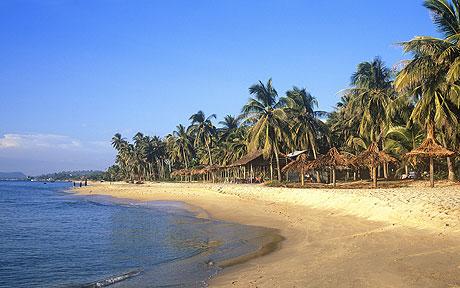
Phu Quoc beach, Vietnam - Photo by Getty
Outside the terminal a little group of drivers are whisking red dust off Japanese four-wheel-drive taxis. In Duong Dong high street, our driver carefully skirts a cow and calf, who regard us with soulful Jersey eyes. "Manchester United," says the driver, using the universal language of south-east Asia. He grins. His English gives out. So does the tarmac. Towing a lofty plume of red dust, we pass a memorial bearing a star and the likeness of Uncle Ho, and jounce into the interior.
Phu Quoc is the biggest island in Vietnam. It sits in the Gulf of Thailand, minding its own business. Until recently, this consisted of the manufacture of a world-beating nuoc mam fish sauce, the cultivation of black and white pepper, and the maintenance of a nature reserve occupying most of the northern part of the island. The fish sauce is so pungent that Vietnamese Airlines is reputed to have installed special sniffers to prevent passengers taking it in their luggage and endangering the purity of the baggage hold; the pepper is undeniably delicious, growing in palm-shaded vineyards in the sandy interior. During the Vietnam War, a camp on its east coast held 40,000 North Vietnamese prisoners, but little trace now remains. As Ho Chi Minh's tanks drove into Saigon and Americans scrambled into choppers on the Embassy roof, the population of Phu Quoc got on with its farming and fishing.
The island's northern extremity lies less than 10 miles from Cambodia, and in 1975 it was briefly invaded by the Khmer Rouge. Soon after the Khmer Rouge had been chased away, backpackers started to arrive. A few hoteliers followed. The four turboprop flights a week became four 64-seater turboprop flights a day. And there they seem to have stuck, for the moment. "We are roughly where Phuket was 25 years ago," said one of the co-proprietors of the Mango Bay Resort, leaning back in his armchair as the sun plunged into the sea.
Phu Quoc now has many hotels, mostly of the beach-bungalow type. Most are concentrated on Long Beach, a 12-mile strip of white sand running south from Duong Dong. Those closest to the town back onto a dusty dual carriageway studded with melancholy hawkers' stalls selling cans of green tea and the aptly-named Harpoon Gin. A safer distance down the beach is La Veranda, an elegant air-conditioned establishment with a swimming pool, cooled towels and sorbets delivered to sunloungers at noon. La Veranda is the poshest spot on the island and appeals to colonial nostalgics with deep pockets. A charming hotel at the opposite extreme is the Bo Resort, on Ong Lang beach well to the north of Duong Dong. Bo is a group of cottages dotted around a beautiful garden on a headland with splendid views over wild sea and empty shore, and knock-down prices.
Somewhere between la Veranda and Bo in both style and location lies Mango Bay. This is an eco-friendly straggle of elegant cottages with verandas, sprawled along three quarters of a mile of wooded coast. More than half the Mango Bay's guests do not leave the resort, and as you lie in the warm, glass-clear water watching a squid boat on the horizon, it is easy to see their point. The restaurant is simple and excellent, the cocktails cheap and powerful, the massages deeply relaxing. One of the three owners has started a butterfly breeding programme and a propagation scheme for endangered orchids that grow wild in Phu Quoc's jungly interior. The cottages are not air-conditioned, but they are made cool and airy by the sea breeze. We lay in the gauzy cloud of our mosquito-netted four-poster, breeze wafting in at the linen-curtained windows of the hardwood bungalow, watching a fat lizard patrolling the bamboo ceiling for stray mosquitoes. The only sounds were the brush of waves on the beach, the distant thud of a fishing boat engine and the hoot of an animal in the far wooded distance. It might have been one of Phu Quoc's resident gibbons. Whatever it was, it was calling us forth to look at the world beyond Mango Bay.
There are rumours (unsubstantiated by recent sightings) that Phu Quoc is one of the few places in the world where dugongs still live. I asked the French hotel manager. "Dugong? Non," he said. "They keep very much to the deep forests of the nature reserve." Suppressing a well-founded suspicion that the dugong is a marine mammal, I asked how we could visit the nature reserve. "You cannot," said the Frenchman, with powerful Gallic finality. "It is for nature, not people."
This was a good point, and unanswerable. So we rented a Honda 50 from one of the Mango Bay's gardeners and set off into a land without tourists.
Red dust rose behind us. Peppercorns wafted spice from the roadside, where they lay drying on blue tarpaulins watched over by Buddhist shrines. The road narrowed to a five-foot path. It wound behind the beach, threaded fishing villages studded with reeking piles of anchovies, crossed causeways through mangrove swamps, passed mile after mile of empty beaches. Farmers had limed their mango orchards with shell-sand. Fish pens the size of kitchen gardens lined the sides of creeks. A watchtower stood in the forest, flying the red flag of the People's Republic, the guard keeping an eye on things from a hammock strategically slung in the gun emplacement. We paused to let two wild bulls fight it out in the middle of the road. A feathery-trousered eagle sailed out of the clouds on the mountains and sat gigantic in a tree, regarding us with a fierce yellow eye.
In the early afternoon we arrived at Cape Ganh Dhau, the island's northwesternmost corner. Howling and clanging emanated from a rickety building overhanging the beach. This turned out to be the proprietor of the local restaurant, a noted poet and electric guitarist. He laid down his guitar to show us to a table on the shaky terrace. Five miles across the sea, the first islands of Cambodia loomed out of their thundercloud. This is smuggling country. Some of the islands in these seas are no-go areas, full of drugs and guns, gangsters and brothels. Another is one of at least six islands on which Captain Kidd is said to have buried his treasure. Lunch arrived.
This consisted of a saucepan of boiling broth on its own gas stove, and slabs of raw fish to cook in it. After a mighty repast of squid and sea snails I waddled onto the beach. Small boys were walking past, eating white berries off sprigs of greenery. A polite child gave me a handful to try; they tasted a little like myrtle. At this point the restaurateur picked up his radio mike and launched into a poem for the benefit of our five fellow lunchers. They clapped politely when he had finished. "What was that?" I said to the slightly bilingual waitress.
"Hymn to Sea Insect," said the girl, watching apprehensively as her boss headed for his guitar.
We drove back to Mango Bay and soaked off the road dust in the warm sea, watching a remora trying to attach itself to a bather until it was time for cocktails at sunset. It had been a day fraught with interest.
Naturally, there are plans to make Phu Quoc even more interesting by bringing in mass tourism. A government minister appeared recently and inaugurated the building of a new international airport capable of accommodating full-sized airliners. Completion is promised for 2012. "Which means 2015," said an Australian in the bar. "If at all." Before the world financial system caught flu, tourism entrepreneurs had parcelled up the island into lots and erected billboards showing vast developments with canals, marinas and thousands of villas. These schemes are now in abeyance, but they may return. Phu Quoc is one of the world's great islands. Go now, while the going is good.
Best time to visit
Between October and April. May and June can be ferociously hot. In July, August and September there is a slim chance of good weather (and a high chance of cut rates in hotels) – but torrential rains turn the roads to red slime and the sea to soup.
How to get there
Vietnam Airlines flies from Ho Chi Minh City and Rach Gia; then get the fare from Ho Chi Minh to Phu Quoc. It is wise to get return tickets, as the small number of daily flights makes it possible to get stuck on the island.
Singapore Airlines offers London to Ho Chi Minh return inc tax from March 3 to April 3. Less frequent ferries are also available from Rach Gia (six hours, daily) and Ha Tien (four hours, every other day). Both these mainland ports can be problematic of access.
Source: by Sam Llewellyn/Telegraph.co.uk
Recommendation in Phu Quoc, Vietnam
- Hotels and Resorts in Phu Quoc
- Beaches in Vietnam
Wednesday, June 10, 2009
Why ACTIVETRAVEL ASIA ?
In 2006 four outdoor enthusiasts who are close friends, Kien (Tony), Bich (Bobby), Bao and Jimmy, decided to take their passion for adventure travel in Asia and create a travel company with a difference: ACTIVETRAVEL ASIA. Today ATA has grown to become one of the Indochina's leading adventure travel companies. We offers a wide selection of Vietnam, Laos, Cambodia and Myanmar adventure tours, including hiking and trekking, biking, motorcycling, overland touring and family travel packages. Our packages and tailor-made private itineraries will take you through exotic destinations to really experience the culture, history and nature of Asia.
 |  |  | |
| Kien (Tony) | Bich (Bobby) | Bao | |
History
In 2006, the ATA first operated in Vietnam with 2 offices in Hanoi and Saigon and a range of unique trekking routes and cycling routes developed in Northern Vietnam and Mekong Delta. Later this year ATA developed the first adventure motorcycling trip on the historic Ho Chi Minh Trail from Hanoi to Hoi An. This trip quickly grasped adventurous riders' interest and has become one of ATA's most successful trips so far.
The next year, 2007, the success of ATA in Vietnam led to increasing forays into neighboring countries, Cambodia and Laos. Cycling route from Mekong Delta to Angkor Wat temples in Siem Riep was explored in early 2007 and two months later, the first expedition was run with 20 pro cyclists from UK. The full operation of ATA in Cambodia and Laos marked with the opening of branch offices in Phnom Penh, Siem Riep and Vientiane.
The increasing demand for adventure travel and the endless passion of our team for exploring hidden lands make us to step further to develop ATA style of adventure travel in other countries in Asia.

A young, dynamic team of ACTIVETRAVEL ASIA - They're ATA's key success
Today
With 4 Years of Experience, we have a deserved reputation for innovation, for quality of service and for providing once-in-a-lifetime active holidays. ATA's accumulated expertise allows you to maximise your precious holiday time and to experience the very best of your chosen destination.
ATA has continued to grow and develop an increasing range of destination and extensive range of adventure trips. Nowadays, ATA operates with 5 offices in major cities in Indochina, a team of professional adventure travel consultants and tour leaders and last but not least an ambition to be the leading adventure tour operator in Asia.

Our trips
We run the most adventure tours available in Indochina and Asia. Our active trips are designed for all levels of outdoor enthusiasts, real people seeking real fun and adventure. Of course, a reasonable level of personal fitness, good health, and interest in outdoor activities is advisable, but you don't need to be a tri-athlete or be an expert in any of the activities you will undertake. Come along and even try something new if you wish. If you like to walk, run, trek, hike, paddle, bike, or go to the gym, you'll love our trips!
_______________________________________________________________
ACTIVETRAVEL ASIA
#31 Alley 4, Dang Van Ngu Street, Hanoi, Vietnam
Phone: +84-4-3573-8569 | Fax: +84-4-3573-8570 | Mobile: +84-979-800-588 | Email: info@activetravel.asia
Skype: ACTIVETRAVEL ASIA
VIETNAM | CAMBODIA | LAOS | MYANMAR | TRAVEL SHOP
Facebook | Twitter


 Posts

