Monday, November 16, 2009

Buying a touring motorbike in Vietnam - Vietnam Motorcycling Travel Guide

By far, the best way to experience Vietnam is by motorbike. As with elsewhere in southeast Asia, here, the motorbike is king. They are cheap to buy, easy to repair, and they can take you places the tour bus would never dare to go. What's more, there are no restrictions on foreigners buying motorbikes. All you need is a passport and valid visa, and you'll receive a title of ownership and a deed of transfer. Rentals will suffice for most, but if you plan on serious bike time, buying is more economical -- you can even sell the bike before you leave and recoup most of the expense.

We know the traffic seems crazy. But once you get the hang of it, you'll learn there is a method to the madness. Travel by motorbike has its dangers, to be sure, and should be undertaken conscientiously. But the vast majority of foreigners come away from their motorbike trek with nothing but great experiences to talk about back home (and maybe a few tail-pipe burns to remember them by).


Vietnam Motorcycling Travel Guide

You can buy a bike almost anywhere, but bigger cities will have a better selection and be more comfortable selling to foreigners. Naturally, it's best to shop around. When you settle on a bike, insist on taking it for a spin -- and to a mechanic for a once over.

Your two main considerations are whether to buy new or used, and how powerful a bike you need. New Japanese and Chinese models can be purchased for as little as US$400. They should be more reliable, but then again, you may be the one stuck working out all the kinks. And you'll take a bath on the resale value.

We recommend a used bike. This may seem a bit daunting, and it's a good idea to make friends with a trustworthy mechanic if you can swing it. When you buy a bike, all you're really looking at is the engine, the shocks, the wheels, and the frame. If nothing's leaking or broken, and it kicks up a throaty hum when it runs, you're off to a good start. Everything else on a bike can be fixed cheaply and easily -- though be sure to factor such repairs into the price you plan to pay.

In terms of power, a 100 cc bike is fine throughout most of the country, depending on the weight you intend to carry. By the time you stack two people and two full packs on it, you'll struggle up the hills even in Da Lat. Northern Vietnam is notoriously hilly and requires at least a 115 cc bike. Check out the bikes used by the guys who do the Easy Rider tours, and look for something similar. If you've never driven a clutch, consider learning -- it quickly becomes second nature.

Even if you buy a bike that's been restored, be sure to take it to a mechanic anyway and put some more money into it. New tires, break drums, batteries, starters and the like are all cheap and will give you that much more peace of mind. Finally, think about where you're going to put your stuff. We got a custom-made back-rack for US$6.25.

When it comes to plotting a route, we suggest planning to see more of the country by seeing less of it. You can't see everything from Sapa to Vung Tau by motorbike in a month. Pick a region -— north, central, or south, and focus on that. Alternately, many buses and trains will take on a motorbike as freight for the price of an extra ticket, so you can split a trip between two regions. Don't plan an overly-aggressive route. The whole point is to take in the scenery, to stop and explore along the way. We find more than 120 kilometres in any given day starts to feel rushed. Fortunately, in thin, compact Vietnam, there is always a good option for your next stop within that distance.

It's also worth mention that, while the 'open road' in Vietnam can be breathtakingly beautiful and provide an utterly authentic experience of the country, this is Vietnam, and not all roads are open. Ask around if you plan to go into remote regions of the country, especially near the borders, but there's really no harm in just trying your luck. The worst that can happen is that the police will ask you to turn around.

Final note: wear a helmet, bring rain gear, and memorize the lyrics to Born to be Wild before you leave. You'll be needing them.

Source: Travelfish.org

Related sites:
Motorcycle Vietnam

Ride Hochiminh Trail

Motorcycling Tours

Wednesday, November 11, 2009

Exploring the Mekong River - from Laos to Vietnam

Some of the most amazing adventure destinations center around the great rivers of the world. Whether it's rafting the Rio Grande, kayaking the Congo, or simply taking a leisurely cruise down the Nile, we seem to have a fascination with these waterways that have played an important role in human development. One of those rivers is the Mekong, which stretches for more than 2700 miles as it meanders through Laos, Thailand, China, Cambodia, Vietnam, and Myanmar.

Mekong River - Vietnam


In Laos, the Mekong is known as the "Mother River" and it plays an important role in that country's culture and lore. Travel writer Kate Quill discovered this for herself recently when she made her own Mekong journey, sharing the details with us in this article from the London Times. Kate spent a week on the river back in October, and describes a tropical landscape filled with dense jungles and rocky peaks.

On her journey up the Mekong, Quill stopped at a remote village that gave her a sense of what life is like for those that depend on the river for their daily needs. Villages like the one she visited remain largely untouched by the outside world, lacking nearly all modern conveniences. She also notes that the Laos' lack of public health care is also evident when interacting with the villagers.

I've been fortunate enough to visit the four longest rivers in the world, spending time on the Nile, Amazon, Yangtze, and Mississippi. Each offered their own unique experiences and glimpses into the cultures of the countries that they flow through. The Mekong seems like it continues this tradition, and offers adventure travelers another destination to add to their list of must see places.

By Kraig Becker

Recommended itineraries
- Mekong Delta river & Angkor Wat tour
- Explore Mekong Delta & river tour
- Family tours in Vietnam


Tuesday, November 10, 2009

Phu Quoc, Vietnam: the coast is clear

Phu Quoc island in Vietnam offers chances to relax on the beach, explore fragrant countryside, marvel at wildlife – and enjoy sumptuous seafood. Just get there before mass tourism, says Sam Llewellyn.

The plane crawls high above the Mekong delta – flooded paddy, intestinal loops of river, roads crammed with Honda 50s and lined with shops selling rice and Marlboros. Then suddenly there is sea, muddy at first, then a cheerful turquoise. The propellers change pitch. The nose drops. A green mountain flicks past the wing, then a white beach. We bank steeply, lining up with a runway on which two people seem to be riding bicycles. And down slams the plane on the pockmarked concrete of Duong Dong airport, gateway to the Vietnamese island of Phu Quoc.


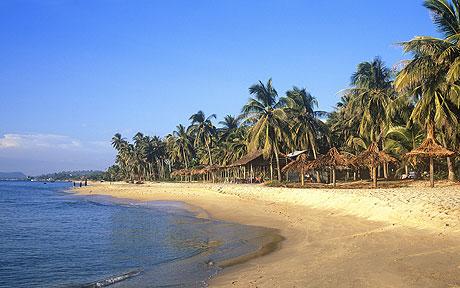
Phu Quoc beach, Vietnam - Photo by Getty


Outside the terminal a little group of drivers are whisking red dust off Japanese four-wheel-drive taxis. In Duong Dong high street, our driver carefully skirts a cow and calf, who regard us with soulful Jersey eyes. "Manchester United," says the driver, using the universal language of south-east Asia. He grins. His English gives out. So does the tarmac. Towing a lofty plume of red dust, we pass a memorial bearing a star and the likeness of Uncle Ho, and jounce into the interior.

Phu Quoc is the biggest island in Vietnam. It sits in the Gulf of Thailand, minding its own business. Until recently, this consisted of the manufacture of a world-beating nuoc mam fish sauce, the cultivation of black and white pepper, and the maintenance of a nature reserve occupying most of the northern part of the island. The fish sauce is so pungent that Vietnamese Airlines is reputed to have installed special sniffers to prevent passengers taking it in their luggage and endangering the purity of the baggage hold; the pepper is undeniably delicious, growing in palm-shaded vineyards in the sandy interior. During the Vietnam War, a camp on its east coast held 40,000 North Vietnamese prisoners, but little trace now remains. As Ho Chi Minh's tanks drove into Saigon and Americans scrambled into choppers on the Embassy roof, the population of Phu Quoc got on with its farming and fishing.

The island's northern extremity lies less than 10 miles from Cambodia, and in 1975 it was briefly invaded by the Khmer Rouge. Soon after the Khmer Rouge had been chased away, backpackers started to arrive. A few hoteliers followed. The four turboprop flights a week became four 64-seater turboprop flights a day. And there they seem to have stuck, for the moment. "We are roughly where Phuket was 25 years ago," said one of the co-proprietors of the Mango Bay Resort, leaning back in his armchair as the sun plunged into the sea.

Phu Quoc now has many hotels, mostly of the beach-bungalow type. Most are concentrated on Long Beach, a 12-mile strip of white sand running south from Duong Dong. Those closest to the town back onto a dusty dual carriageway studded with melancholy hawkers' stalls selling cans of green tea and the aptly-named Harpoon Gin. A safer distance down the beach is La Veranda, an elegant air-conditioned establishment with a swimming pool, cooled towels and sorbets delivered to sunloungers at noon. La Veranda is the poshest spot on the island and appeals to colonial nostalgics with deep pockets. A charming hotel at the opposite extreme is the Bo Resort, on Ong Lang beach well to the north of Duong Dong. Bo is a group of cottages dotted around a beautiful garden on a headland with splendid views over wild sea and empty shore, and knock-down prices.

Somewhere between la Veranda and Bo in both style and location lies Mango Bay. This is an eco-friendly straggle of elegant cottages with verandas, sprawled along three quarters of a mile of wooded coast. More than half the Mango Bay's guests do not leave the resort, and as you lie in the warm, glass-clear water watching a squid boat on the horizon, it is easy to see their point. The restaurant is simple and excellent, the cocktails cheap and powerful, the massages deeply relaxing. One of the three owners has started a butterfly breeding programme and a propagation scheme for endangered orchids that grow wild in Phu Quoc's jungly interior. The cottages are not air-conditioned, but they are made cool and airy by the sea breeze. We lay in the gauzy cloud of our mosquito-netted four-poster, breeze wafting in at the linen-curtained windows of the hardwood bungalow, watching a fat lizard patrolling the bamboo ceiling for stray mosquitoes. The only sounds were the brush of waves on the beach, the distant thud of a fishing boat engine and the hoot of an animal in the far wooded distance. It might have been one of Phu Quoc's resident gibbons. Whatever it was, it was calling us forth to look at the world beyond Mango Bay.

There are rumours (unsubstantiated by recent sightings) that Phu Quoc is one of the few places in the world where dugongs still live. I asked the French hotel manager. "Dugong? Non," he said. "They keep very much to the deep forests of the nature reserve." Suppressing a well-founded suspicion that the dugong is a marine mammal, I asked how we could visit the nature reserve. "You cannot," said the Frenchman, with powerful Gallic finality. "It is for nature, not people."

This was a good point, and unanswerable. So we rented a Honda 50 from one of the Mango Bay's gardeners and set off into a land without tourists.

Red dust rose behind us. Peppercorns wafted spice from the roadside, where they lay drying on blue tarpaulins watched over by Buddhist shrines. The road narrowed to a five-foot path. It wound behind the beach, threaded fishing villages studded with reeking piles of anchovies, crossed causeways through mangrove swamps, passed mile after mile of empty beaches. Farmers had limed their mango orchards with shell-sand. Fish pens the size of kitchen gardens lined the sides of creeks. A watchtower stood in the forest, flying the red flag of the People's Republic, the guard keeping an eye on things from a hammock strategically slung in the gun emplacement. We paused to let two wild bulls fight it out in the middle of the road. A feathery-trousered eagle sailed out of the clouds on the mountains and sat gigantic in a tree, regarding us with a fierce yellow eye.

In the early afternoon we arrived at Cape Ganh Dhau, the island's northwesternmost corner. Howling and clanging emanated from a rickety building overhanging the beach. This turned out to be the proprietor of the local restaurant, a noted poet and electric guitarist. He laid down his guitar to show us to a table on the shaky terrace. Five miles across the sea, the first islands of Cambodia loomed out of their thundercloud. This is smuggling country. Some of the islands in these seas are no-go areas, full of drugs and guns, gangsters and brothels. Another is one of at least six islands on which Captain Kidd is said to have buried his treasure. Lunch arrived.

This consisted of a saucepan of boiling broth on its own gas stove, and slabs of raw fish to cook in it. After a mighty repast of squid and sea snails I waddled onto the beach. Small boys were walking past, eating white berries off sprigs of greenery. A polite child gave me a handful to try; they tasted a little like myrtle. At this point the restaurateur picked up his radio mike and launched into a poem for the benefit of our five fellow lunchers. They clapped politely when he had finished. "What was that?" I said to the slightly bilingual waitress.

"Hymn to Sea Insect," said the girl, watching apprehensively as her boss headed for his guitar.

We drove back to Mango Bay and soaked off the road dust in the warm sea, watching a remora trying to attach itself to a bather until it was time for cocktails at sunset. It had been a day fraught with interest.

Naturally, there are plans to make Phu Quoc even more interesting by bringing in mass tourism. A government minister appeared recently and inaugurated the building of a new international airport capable of accommodating full-sized airliners. Completion is promised for 2012. "Which means 2015," said an Australian in the bar. "If at all." Before the world financial system caught flu, tourism entrepreneurs had parcelled up the island into lots and erected billboards showing vast developments with canals, marinas and thousands of villas. These schemes are now in abeyance, but they may return. Phu Quoc is one of the world's great islands. Go now, while the going is good.

Best time to visit

Between October and April. May and June can be ferociously hot. In July, August and September there is a slim chance of good weather (and a high chance of cut rates in hotels) – but torrential rains turn the roads to red slime and the sea to soup.

How to get there

Vietnam Airlines flies from Ho Chi Minh City and Rach Gia; then get the fare from Ho Chi Minh to Phu Quoc. It is wise to get return tickets, as the small number of daily flights makes it possible to get stuck on the island.

Singapore Airlines offers London to Ho Chi Minh return inc tax from March 3 to April 3. Less frequent ferries are also available from Rach Gia (six hours, daily) and Ha Tien (four hours, every other day). Both these mainland ports can be problematic of access.

Source: by Sam Llewellyn/Telegraph.co.uk

Recommendation in Phu Quoc, Vietnam
- Hotels and Resorts in Phu Quoc
- Beaches in Vietnam


Sunday, November 8, 2009

Riverside Paradise - Xong river in Vangvieng, Laos


A small and beautiful town surrounded by mountains and rivers, Vangvieng is a place of delight and wonder for visitors from around the world.

The city is about 150 km north of Vientiane, situated between the capital city and the World Heritage town of Luang Prabang. The main attractions are the clean and clear water of the Nam Xong river, karst outcroppings, caves and mountain scenery. The town has more than 30 natural caves, and most places of interest are accessible to visitors all year round.


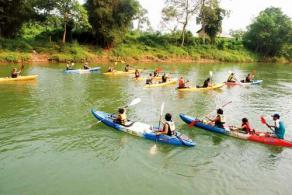
Kayaking in Vangvieng, Laos

Laos is steeped in Buddhist traditions, has a colourful culture and is famed for the year-round tropical weather that makes it a lush paradise. The people who live here hold many traditional festivals so that local customs live on.

In the mean time the tourists from around the world who visit Vangvieng congregate around the river, with venues in the town becoming meeting points where people make friends as they enjoy fun and games.

Recently, tourism operators have built facilities to serve the visitors’ need for excitement as full as possible along the river. These include zip-lines, rope swings, slides, and mud pits for games of rattan ball and volleyball.

For a three-kilometre stretch on the river before the launch point of inner tubes and kayaks, people can be seen happily drinking and dancing, enjoying the music, riverside merriment and sport.
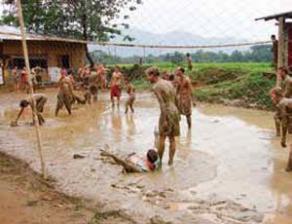
Impromptu games involve an unlimited number of players, both male and female. Whether a player is good or not is of no importance. People are perfectly content to engage in friendly competition, while relishing the freedom and comfort of swim-wear and mud. Of course there are no rules either; the objective is to hit the ball over the net and enjoy the refreshing surroundings and the company of friends new and old.

Mud pit volleyball in Vangvieng, Laos
This sort of unabashed volleyball revelry played out in the mud may not be an unusual site in some countries, but in Laos it is certainly a rarity.

Vangvieng is the first and only place to feature mud pit volleyball in Laos! In fact, the only other instance of mud-based excitement in the country is seen during the rocket festival. There, if a rocket explodes on the launching pad instead of taking to the sky, the rocket engineer and his team will be thrown into a mud pit by the other rocketeers. But this only happens once a year, while Vangvieng players can serve, volley and wallow in the pit every day.

Making the “mud court” is not complicated and involves simply taking mud from farms in the area and pouring it into the pit. The only extra effort goes into making sure the mud doesn’t contain any large rocks or other hard objects, which might injure the players. Smartly, the court is equipped with nylon nets to keep the ball from going too far out of play.

When players grow tired and mud-caked from all the volleying, they will most likely be seen heartily throwing one another into the river. Viola! It’s a fast, easy and fun method of cleaning up after the game.

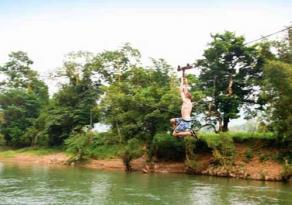
Jumping into Xong river, Vangvieng, Laos
Still, revellers shouldn’t forget that safety is extremely important in this type of setting. To prevent tourists from drowning after they have jumped or swung into the river, some locals are specially designated to be on the lookout for those in need of a helping hand. They throw out small inner tubes tied to a rope and pull them back to land. This can be quite useful, especially for those who are not the strongest of swimmers.

Moreover, merrymakers cannot disregard the environmental integrity of the area.

To protect the river, district authorities have created regulations banning tourist operators from allowing visitors to bring any glass bottles to the riverside, nor in kayaks or inner tubes.

Though several kinds of beverages are available at bars along the river, especially at places where overhead jumps are set up, tourists are not allowed to take any bottles away with them. Servers pour drinks into small plastic buckets and require them to stay put.

Splashing and sporting around are good for some, but what makes Vangvieng an interesting destination is its dynamism. There seems to be something for everyone here. Visitors who don’t want to play in the mud or jump into the river can simply enjoy taking photographs and taking pleasure in the beauty of their surroundings. There are caves to explore, organic farms to visit, and local culture and traditions to get lost in.

Lao visitors, especially from Vientiane, like to shop at the market for fresh organic vegetables and fruits in the early morning. Here, one can see the real life of Vangvieng residents, who come from different villages and ethnic groups and sell and buy goods in the market. Not only are many of the goods for sale here interesting and unusual, they are also cheaper than in Vientiane markets.

To tempt tourists to linger longer in Vangvieng, investors have developed numerous amenities for visitors to enjoy. In the town centre, hundreds of restaurants pepper the roads, many of them decorated with coloured lights and bright flowers, while others feature popular TV series that run non-stop.

At the visitor’s fingertips are overseas television channels, Internet cafes, currency exchange units and transaction services that allow connection with the rest of the world. Travel agencies, as well as trekking, tubing and kayaking operations, are not at all difficult to find in the town centre.

Travellers can relax, drink and savour their favourite foods in the many eateries. The town is not lacking in international fare. Some cooks are even willing to prepare made-to-order meals for visitors, to sate their Western-style cravings.

Yet, those seeking a more cultural experience will not be disappointed— Lao cuisine and libations are readily available. Among the most popular beverages for tourists are Beerlao, fruit shakes, organic wine and tea made from mulberry leaves.

Vangvieng has more than 100 guesthouses, hotels, resorts and bungalows to accommodate tourists who visit the town. If you find your way to this dynamic and charming place, remember to go easy on the lao-lao, respect the natural beauty, and leave only your troubles to float down the river.

By Feature writer in Vanvieng/ Vientiane Times/ Asia News Network

Recommendation in Laos:
- Laos Travel Guide
- Kayak Vangvieng, Laos
- Adventure travel in Laos


Thursday, November 5, 2009

Asia Adventure Holidays: Hot Tips for 2010 in Vietnam, Cambodia and Laos

We asked the experts to reveal the trips they are most excited about – from Vietnam's Fansipan Mountain to Cambodia's Tonle Sap Lake.

1. MOUNTAIN TREKKING, SAPA, VIETNAM

Mount Fansipan is Vietnam’s highest peak located in the far north just outside of Sapa. Mt. Fansipan a very steep mountain that gets a lot of moisture. Those looking to climb it should be in good shape and prepared to to have muddy wet feet. The scenery is incredible remember to bring a camera. For most of Vietnam having a rain coat is a little excessive because it is so warm. On the mountain having a rain coat is not a bad idea especially at night. The trails around Sapa are a lot of fun. You will get the chance to go through some minority villages if you have the time to explore. There are well-marked trails, both long and short, for all skill levels.


Conquer Fansipan Mountain, the highest mountain in Indochina- Vietnam.
Photograph: Active Travel Vietnam

When? October to May are the best months

Book it: Trek Fansipan (00 84 4 3573 8569; trekfansipan.com) offers a year-round, four-day guided mountain-trekking tour of Vietnam from $ 219 including hotel accommodation, some meals and travel gear rent. Flights extra.

2. MOTORCYCLING HO CHI MINH TRAIL, VIETNAM

The legendary Ho Chi Minh Trail was the supply line used by North Vietnam to link North and South Vietnam during the American War. Soldiers, ammunition, weapons and supplies were carried by hand, bicycle and truck for hundreds of kilometers through the otherwise impenetrable jungle that covered Vietnam’s mountainous border with Laos. A testimony to the ingenuity, fortitude and commitment of the northern Vietnamese, the trail slipped from use at the end of the war and was taken back by the jungle.


Ho Chi Minh Trail Motorcycling tour - Photo by ATA


When? October to April

Book it: Active Travel Vietnam (info@activetravelvietnam.com; activetravelvietnam.com) offers a 18-days trip with 11-days motorcycling guided trip from $1,951, including accommodation, all meals and transfers. Flights extra.

3. KAYAKING HALONG BAY, VIETNAM
Ha Long Bay (also “Halong Bay”) is in northern Vietnam, 170 km east of Hanoi. The bay is famous for its scenic rock formations.If you thought the hideout in the James Bond film “The Man with the Golden Gun” was spectacular, imagine a place where there are 3,000 such limestone islands clustered together in the East Sea of Halong Bay. Paddle through caves into secret lagoons, drift down channels surrounded by cliffs and forest and sail out into the open sea.


Kayaking on Halong bay, Vietnam

When? October and early January

Book it: Kayak Halong Bay (info@activetravel.asia; kayakhalongbay.com) offers a 3-day trip from $ 299, including meals, accommodation and transfers

4. EXPLORE MEKONG DELTA

A holiday in Vietnam would be incomplete without a trip to the Mekong Delta, Vietnam. Popularly known as one of the ‘Rice Baskets’ of Vietnam, the Mekong Delta is located in the South Eastern region of Vietnam, where the Mekong River meets the sea. A pride of the Vietnamese and the one of the most popular of the Vietnam tourist attractions, the Mekong Delta is exceptionally rich in scenic beauty. It is a place unique in itself.


Float market in Mekong Delta, Vietnam

When? October to June

Book it: Active Travel Asia (info@activetravel.asia; activetravel.asia) has a 4-day tour with over 3-day biking from $ 312 including full-board accommodation and transfers. Flights extra

5. CYCLING ANGKOR WAT, CAMBODIA

Let’s discover the world’s remarkable awesome historical site through this adventure trip and grasp the reasons why the Tomb Raider’s film maker team chose the Angkor Complex in Siem Reap for its screen backdrops. Also experience the biodiversity of Tonle Sap listed as the World Ecological Wonder.


Monks and Angkor Wat, Cambodia

When? October to June

Book it: Active Travel Cambodia (info@activetravelcambodia.com; activetravelcambodia.com) has a 7-day tour with 5-day cycling from $ 685 including full-board accommodation and transfers. Flights extra

6. CYCLING LAOS
Cycling is a great way to get off the beaten track in this increasingly popular country. Start in Luang Prabang, in north central Laos, and head to Hanoi, in North Vietnam, travelling along the banks of the Mekong River and past the intriguing Viengxay caves.


On the way bike Luang Prabang, Laos
- Photo by ATA

When? October to March

Book it: Active Travel Laos (info@activetravellaos.com; activetravellaos.com) has a 17-day tour with kayaking, trekking, biking and elephant riding Luang Prabang to Hanoi cycling trip from $ 1,553, including most meals, bike hire and sightseeing. Flights extra.