Tuesday, November 10, 2009

Phu Quoc, Vietnam: the coast is clear

Phu Quoc island in Vietnam offers chances to relax on the beach, explore fragrant countryside, marvel at wildlife – and enjoy sumptuous seafood. Just get there before mass tourism, says Sam Llewellyn.

The plane crawls high above the Mekong delta – flooded paddy, intestinal loops of river, roads crammed with Honda 50s and lined with shops selling rice and Marlboros. Then suddenly there is sea, muddy at first, then a cheerful turquoise. The propellers change pitch. The nose drops. A green mountain flicks past the wing, then a white beach. We bank steeply, lining up with a runway on which two people seem to be riding bicycles. And down slams the plane on the pockmarked concrete of Duong Dong airport, gateway to the Vietnamese island of Phu Quoc.
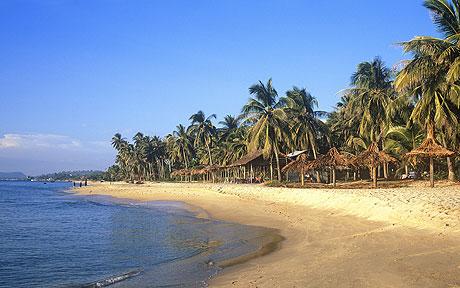
 

Phu Quoc beach, Vietnam - Photo by Getty


Outside the terminal a little group of drivers are whisking red dust off Japanese four-wheel-drive taxis. In Duong Dong high street, our driver carefully skirts a cow and calf, who regard us with soulful Jersey eyes. "Manchester United," says the driver, using the universal language of south-east Asia. He grins. His English gives out. So does the tarmac. Towing a lofty plume of red dust, we pass a memorial bearing a star and the likeness of Uncle Ho, and jounce into the interior.

Phu Quoc is the biggest island in Vietnam. It sits in the Gulf of Thailand, minding its own business. Until recently, this consisted of the manufacture of a world-beating nuoc mam fish sauce, the cultivation of black and white pepper, and the maintenance of a nature reserve occupying most of the northern part of the island. The fish sauce is so pungent that Vietnamese Airlines is reputed to have installed special sniffers to prevent passengers taking it in their luggage and endangering the purity of the baggage hold; the pepper is undeniably delicious, growing in palm-shaded vineyards in the sandy interior. During the Vietnam War, a camp on its east coast held 40,000 North Vietnamese prisoners, but little trace now remains. As Ho Chi Minh's tanks drove into Saigon and Americans scrambled into choppers on the Embassy roof, the population of Phu Quoc got on with its farming and fishing.

The island's northern extremity lies less than 10 miles from Cambodia, and in 1975 it was briefly invaded by the Khmer Rouge. Soon after the Khmer Rouge had been chased away, backpackers started to arrive. A few hoteliers followed. The four turboprop flights a week became four 64-seater turboprop flights a day. And there they seem to have stuck, for the moment. "We are roughly where Phuket was 25 years ago," said one of the co-proprietors of the Mango Bay Resort, leaning back in his armchair as the sun plunged into the sea.

Phu Quoc now has many hotels, mostly of the beach-bungalow type. Most are concentrated on Long Beach, a 12-mile strip of white sand running south from Duong Dong. Those closest to the town back onto a dusty dual carriageway studded with melancholy hawkers' stalls selling cans of green tea and the aptly-named Harpoon Gin. A safer distance down the beach is La Veranda, an elegant air-conditioned establishment with a swimming pool, cooled towels and sorbets delivered to sunloungers at noon. La Veranda is the poshest spot on the island and appeals to colonial nostalgics with deep pockets. A charming hotel at the opposite extreme is the Bo Resort, on Ong Lang beach well to the north of Duong Dong. Bo is a group of cottages dotted around a beautiful garden on a headland with splendid views over wild sea and empty shore, and knock-down prices.

Somewhere between la Veranda and Bo in both style and location lies Mango Bay. This is an eco-friendly straggle of elegant cottages with verandas, sprawled along three quarters of a mile of wooded coast. More than half the Mango Bay's guests do not leave the resort, and as you lie in the warm, glass-clear water watching a squid boat on the horizon, it is easy to see their point. The restaurant is simple and excellent, the cocktails cheap and powerful, the massages deeply relaxing. One of the three owners has started a butterfly breeding programme and a propagation scheme for endangered orchids that grow wild in Phu Quoc's jungly interior. The cottages are not air-conditioned, but they are made cool and airy by the sea breeze. We lay in the gauzy cloud of our mosquito-netted four-poster, breeze wafting in at the linen-curtained windows of the hardwood bungalow, watching a fat lizard patrolling the bamboo ceiling for stray mosquitoes. The only sounds were the brush of waves on the beach, the distant thud of a fishing boat engine and the hoot of an animal in the far wooded distance. It might have been one of Phu Quoc's resident gibbons. Whatever it was, it was calling us forth to look at the world beyond Mango Bay.

There are rumours (unsubstantiated by recent sightings) that Phu Quoc is one of the few places in the world where dugongs still live. I asked the French hotel manager. "Dugong? Non," he said. "They keep very much to the deep forests of the nature reserve." Suppressing a well-founded suspicion that the dugong is a marine mammal, I asked how we could visit the nature reserve. "You cannot," said the Frenchman, with powerful Gallic finality. "It is for nature, not people."

This was a good point, and unanswerable. So we rented a Honda 50 from one of the Mango Bay's gardeners and set off into a land without tourists.

Red dust rose behind us. Peppercorns wafted spice from the roadside, where they lay drying on blue tarpaulins watched over by Buddhist shrines. The road narrowed to a five-foot path. It wound behind the beach, threaded fishing villages studded with reeking piles of anchovies, crossed causeways through mangrove swamps, passed mile after mile of empty beaches. Farmers had limed their mango orchards with shell-sand. Fish pens the size of kitchen gardens lined the sides of creeks. A watchtower stood in the forest, flying the red flag of the People's Republic, the guard keeping an eye on things from a hammock strategically slung in the gun emplacement. We paused to let two wild bulls fight it out in the middle of the road. A feathery-trousered eagle sailed out of the clouds on the mountains and sat gigantic in a tree, regarding us with a fierce yellow eye.

In the early afternoon we arrived at Cape Ganh Dhau, the island's northwesternmost corner. Howling and clanging emanated from a rickety building overhanging the beach. This turned out to be the proprietor of the local restaurant, a noted poet and electric guitarist. He laid down his guitar to show us to a table on the shaky terrace. Five miles across the sea, the first islands of Cambodia loomed out of their thundercloud. This is smuggling country. Some of the islands in these seas are no-go areas, full of drugs and guns, gangsters and brothels. Another is one of at least six islands on which Captain Kidd is said to have buried his treasure. Lunch arrived.

This consisted of a saucepan of boiling broth on its own gas stove, and slabs of raw fish to cook in it. After a mighty repast of squid and sea snails I waddled onto the beach. Small boys were walking past, eating white berries off sprigs of greenery. A polite child gave me a handful to try; they tasted a little like myrtle. At this point the restaurateur picked up his radio mike and launched into a poem for the benefit of our five fellow lunchers. They clapped politely when he had finished. "What was that?" I said to the slightly bilingual waitress.

"Hymn to Sea Insect," said the girl, watching apprehensively as her boss headed for his guitar.

We drove back to Mango Bay and soaked off the road dust in the warm sea, watching a remora trying to attach itself to a bather until it was time for cocktails at sunset. It had been a day fraught with interest.

Naturally, there are plans to make Phu Quoc even more interesting by bringing in mass tourism. A government minister appeared recently and inaugurated the building of a new international airport capable of accommodating full-sized airliners. Completion is promised for 2012. "Which means 2015," said an Australian in the bar. "If at all." Before the world financial system caught flu, tourism entrepreneurs had parcelled up the island into lots and erected billboards showing vast developments with canals, marinas and thousands of villas. These schemes are now in abeyance, but they may return. Phu Quoc is one of the world's great islands. Go now, while the going is good.

Best time to visit

Between October and April. May and June can be ferociously hot. In July, August and September there is a slim chance of good weather (and a high chance of cut rates in hotels) – but torrential rains turn the roads to red slime and the sea to soup.

How to get there

Vietnam Airlines flies from Ho Chi Minh City and Rach Gia; then get the fare from Ho Chi Minh to Phu Quoc. It is wise to get return tickets, as the small number of daily flights makes it possible to get stuck on the island.

Singapore Airlines offers London to Ho Chi Minh return inc tax from March 3 to April 3. Less frequent ferries are also available from Rach Gia (six hours, daily) and Ha Tien (four hours, every other day). Both these mainland ports can be problematic of access.

Source: by Sam Llewellyn/Telegraph.co.uk

Recommendation in Phu Quoc, Vietnam
- Hotels and Resorts in Phu Quoc
- Beaches in Vietnam


Sunday, November 8, 2009

Riverside Paradise - Xong river in Vangvieng, Laos


A small and beautiful town surrounded by mountains and rivers, Vangvieng is a place of delight and wonder for visitors from around the world.

The city is about 150 km north of Vientiane, situated between the capital city and the World Heritage town of Luang Prabang. The main attractions are the clean and clear water of the Nam Xong river, karst outcroppings, caves and mountain scenery. The town has more than 30 natural caves, and most places of interest are accessible to visitors all year round.


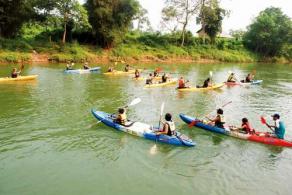
Kayaking in Vangvieng, Laos

Laos is steeped in Buddhist traditions, has a colourful culture and is famed for the year-round tropical weather that makes it a lush paradise. The people who live here hold many traditional festivals so that local customs live on.

In the mean time the tourists from around the world who visit Vangvieng congregate around the river, with venues in the town becoming meeting points where people make friends as they enjoy fun and games.

Recently, tourism operators have built facilities to serve the visitors’ need for excitement as full as possible along the river. These include zip-lines, rope swings, slides, and mud pits for games of rattan ball and volleyball.

For a three-kilometre stretch on the river before the launch point of inner tubes and kayaks, people can be seen happily drinking and dancing, enjoying the music, riverside merriment and sport.
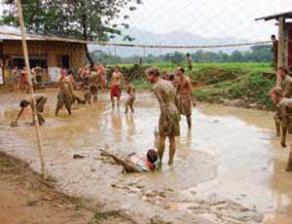
Impromptu games involve an unlimited number of players, both male and female. Whether a player is good or not is of no importance. People are perfectly content to engage in friendly competition, while relishing the freedom and comfort of swim-wear and mud. Of course there are no rules either; the objective is to hit the ball over the net and enjoy the refreshing surroundings and the company of friends new and old.

Mud pit volleyball in Vangvieng, Laos
This sort of unabashed volleyball revelry played out in the mud may not be an unusual site in some countries, but in Laos it is certainly a rarity.

Vangvieng is the first and only place to feature mud pit volleyball in Laos! In fact, the only other instance of mud-based excitement in the country is seen during the rocket festival. There, if a rocket explodes on the launching pad instead of taking to the sky, the rocket engineer and his team will be thrown into a mud pit by the other rocketeers. But this only happens once a year, while Vangvieng players can serve, volley and wallow in the pit every day.

Making the “mud court” is not complicated and involves simply taking mud from farms in the area and pouring it into the pit. The only extra effort goes into making sure the mud doesn’t contain any large rocks or other hard objects, which might injure the players. Smartly, the court is equipped with nylon nets to keep the ball from going too far out of play.

When players grow tired and mud-caked from all the volleying, they will most likely be seen heartily throwing one another into the river. Viola! It’s a fast, easy and fun method of cleaning up after the game.

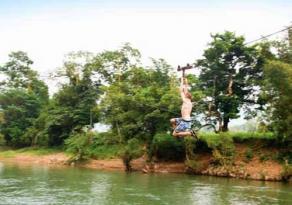
Jumping into Xong river, Vangvieng, Laos
Still, revellers shouldn’t forget that safety is extremely important in this type of setting. To prevent tourists from drowning after they have jumped or swung into the river, some locals are specially designated to be on the lookout for those in need of a helping hand. They throw out small inner tubes tied to a rope and pull them back to land. This can be quite useful, especially for those who are not the strongest of swimmers.

Moreover, merrymakers cannot disregard the environmental integrity of the area.

To protect the river, district authorities have created regulations banning tourist operators from allowing visitors to bring any glass bottles to the riverside, nor in kayaks or inner tubes.

Though several kinds of beverages are available at bars along the river, especially at places where overhead jumps are set up, tourists are not allowed to take any bottles away with them. Servers pour drinks into small plastic buckets and require them to stay put.

Splashing and sporting around are good for some, but what makes Vangvieng an interesting destination is its dynamism. There seems to be something for everyone here. Visitors who don’t want to play in the mud or jump into the river can simply enjoy taking photographs and taking pleasure in the beauty of their surroundings. There are caves to explore, organic farms to visit, and local culture and traditions to get lost in.

Lao visitors, especially from Vientiane, like to shop at the market for fresh organic vegetables and fruits in the early morning. Here, one can see the real life of Vangvieng residents, who come from different villages and ethnic groups and sell and buy goods in the market. Not only are many of the goods for sale here interesting and unusual, they are also cheaper than in Vientiane markets.

To tempt tourists to linger longer in Vangvieng, investors have developed numerous amenities for visitors to enjoy. In the town centre, hundreds of restaurants pepper the roads, many of them decorated with coloured lights and bright flowers, while others feature popular TV series that run non-stop.

At the visitor’s fingertips are overseas television channels, Internet cafes, currency exchange units and transaction services that allow connection with the rest of the world. Travel agencies, as well as trekking, tubing and kayaking operations, are not at all difficult to find in the town centre.

Travellers can relax, drink and savour their favourite foods in the many eateries. The town is not lacking in international fare. Some cooks are even willing to prepare made-to-order meals for visitors, to sate their Western-style cravings.

Yet, those seeking a more cultural experience will not be disappointed— Lao cuisine and libations are readily available. Among the most popular beverages for tourists are Beerlao, fruit shakes, organic wine and tea made from mulberry leaves.

Vangvieng has more than 100 guesthouses, hotels, resorts and bungalows to accommodate tourists who visit the town. If you find your way to this dynamic and charming place, remember to go easy on the lao-lao, respect the natural beauty, and leave only your troubles to float down the river.

By Feature writer in Vanvieng/ Vientiane Times/ Asia News Network

Recommendation in Laos:
- Laos Travel Guide
- Kayak Vangvieng, Laos
- Adventure travel in Laos


Thursday, November 5, 2009

Asia Adventure Holidays: Hot Tips for 2010 in Vietnam, Cambodia and Laos

We asked the experts to reveal the trips they are most excited about – from Vietnam's Fansipan Mountain to Cambodia's Tonle Sap Lake.

1. MOUNTAIN TREKKING, SAPA, VIETNAM

Mount Fansipan is Vietnam’s highest peak located in the far north just outside of Sapa. Mt. Fansipan a very steep mountain that gets a lot of moisture. Those looking to climb it should be in good shape and prepared to to have muddy wet feet. The scenery is incredible remember to bring a camera. For most of Vietnam having a rain coat is a little excessive because it is so warm. On the mountain having a rain coat is not a bad idea especially at night. The trails around Sapa are a lot of fun. You will get the chance to go through some minority villages if you have the time to explore. There are well-marked trails, both long and short, for all skill levels.


Conquer Fansipan Mountain, the highest mountain in Indochina- Vietnam.
Photograph: Active Travel Vietnam

When? October to May are the best months

Book it: Trek Fansipan (00 84 4 3573 8569; trekfansipan.com) offers a year-round, four-day guided mountain-trekking tour of Vietnam from $ 219 including hotel accommodation, some meals and travel gear rent. Flights extra.

2. MOTORCYCLING HO CHI MINH TRAIL, VIETNAM

The legendary Ho Chi Minh Trail was the supply line used by North Vietnam to link North and South Vietnam during the American War. Soldiers, ammunition, weapons and supplies were carried by hand, bicycle and truck for hundreds of kilometers through the otherwise impenetrable jungle that covered Vietnam’s mountainous border with Laos. A testimony to the ingenuity, fortitude and commitment of the northern Vietnamese, the trail slipped from use at the end of the war and was taken back by the jungle.


Ho Chi Minh Trail Motorcycling tour - Photo by ATA


When? October to April

Book it: Active Travel Vietnam (info@activetravelvietnam.com; activetravelvietnam.com) offers a 18-days trip with 11-days motorcycling guided trip from $1,951, including accommodation, all meals and transfers. Flights extra.

3. KAYAKING HALONG BAY, VIETNAM
Ha Long Bay (also “Halong Bay”) is in northern Vietnam, 170 km east of Hanoi. The bay is famous for its scenic rock formations.If you thought the hideout in the James Bond film “The Man with the Golden Gun” was spectacular, imagine a place where there are 3,000 such limestone islands clustered together in the East Sea of Halong Bay. Paddle through caves into secret lagoons, drift down channels surrounded by cliffs and forest and sail out into the open sea.


Kayaking on Halong bay, Vietnam

When? October and early January

Book it: Kayak Halong Bay (info@activetravel.asia; kayakhalongbay.com) offers a 3-day trip from $ 299, including meals, accommodation and transfers

4. EXPLORE MEKONG DELTA

A holiday in Vietnam would be incomplete without a trip to the Mekong Delta, Vietnam. Popularly known as one of the ‘Rice Baskets’ of Vietnam, the Mekong Delta is located in the South Eastern region of Vietnam, where the Mekong River meets the sea. A pride of the Vietnamese and the one of the most popular of the Vietnam tourist attractions, the Mekong Delta is exceptionally rich in scenic beauty. It is a place unique in itself.


Float market in Mekong Delta, Vietnam

When? October to June

Book it: Active Travel Asia (info@activetravel.asia; activetravel.asia) has a 4-day tour with over 3-day biking from $ 312 including full-board accommodation and transfers. Flights extra

5. CYCLING ANGKOR WAT, CAMBODIA

Let’s discover the world’s remarkable awesome historical site through this adventure trip and grasp the reasons why the Tomb Raider’s film maker team chose the Angkor Complex in Siem Reap for its screen backdrops. Also experience the biodiversity of Tonle Sap listed as the World Ecological Wonder.


Monks and Angkor Wat, Cambodia

When? October to June

Book it: Active Travel Cambodia (info@activetravelcambodia.com; activetravelcambodia.com) has a 7-day tour with 5-day cycling from $ 685 including full-board accommodation and transfers. Flights extra

6. CYCLING LAOS
Cycling is a great way to get off the beaten track in this increasingly popular country. Start in Luang Prabang, in north central Laos, and head to Hanoi, in North Vietnam, travelling along the banks of the Mekong River and past the intriguing Viengxay caves.


On the way bike Luang Prabang, Laos
- Photo by ATA

When? October to March

Book it: Active Travel Laos (info@activetravellaos.com; activetravellaos.com) has a 17-day tour with kayaking, trekking, biking and elephant riding Luang Prabang to Hanoi cycling trip from $ 1,553, including most meals, bike hire and sightseeing. Flights extra.

Tuesday, November 3, 2009

Vietnam: the rewards of peace

Modern Vietnam has many attractions, says Tim Jepson, but one event from its recent past still looms above all others.

Don't mention the war. This, more or less, is the gist of my Rough Guide to Vietnam. Or, more accurately – and I'm paraphrasing here – don't become obsessed by the war. But it's hard when visiting a country where the association, for me at least, is immediate and inescapable: Vietnam – war.

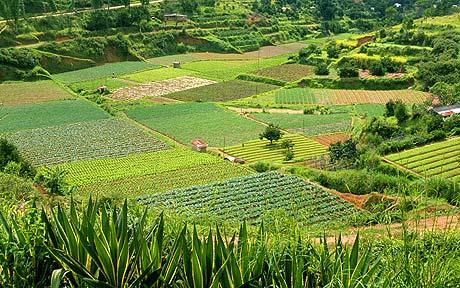
Countryside in Dalat, Vietnam - Photo by Getty


The closeness of the real world must have been the strangest thing, I think, as I sit reading the guide and looking down on miles of jungle during my flight from Bangkok to Ho Chi Minh City, better known by its former name, Saigon. It's just an hour from the Thai capital to a city synonymous with war: just an hour for all those GIs between fighting and the various pleasures afforded by a few days' leave in Bangkok.


Returning to who knows what, doubtless in far less comfort, they would have looked down on the same landscape: the jungle-covered hills, the numerous tiny villages, the sudden, sprawling urban scar of Phnom Penh, and then the majestic, churning waters of the Saigon and Mekong rivers, sweeping in vast brown meanders through emerald paddy fields.

As we come in to land, it's impossible not to note that Saigon's airport was obviously once much larger – the outlines of buildings long gone are still clear from the air. Nor to ignore the rows and rows of bunkers once used to shelter assault helicopters, their ageing concrete, for now, resistant to the effects of time and tropical weather. In this part of Vietnam, the war is right there, right from the start.

Impossible, too, not to notice the victors' symbol, the red flag and hammer and sickle – not an image one often sees these days – adorning the airport and most of the streets and larger public buildings as we drive through Saigon.

And so to hot, humid Saigon itself, a place that manages to be modern and moribund at the same time. I know you shouldn't judge a place solely on its sights, but the city, as far as I can make out, has just two things to see: the swarms of motorcycles, weaving and jostling on every street as if in some exhaust-filled ballet; and Vietnam's most popular tourist "attraction" – the War Remnants Museum.

The latter is a nasty, graceless old-fashioned sort of museum, housed in a bleak, crumbling Eastern Bloc-style building and a few ramshackle Fifties huts around a courtyard full of hawkers, beggars, tanks, bombs, howitzers, a US helicopter and other twisted-metal memorials to the events of 35 years ago.

Nasty and graceless, but utterly compelling. Especially the helicopter, of a sort you've seen in all those war movies. Its interior is virtually bare, utterly stripped down to basics, its battered, dirty, spartan appearance strangely, eerily redolent of combat. For some reason, I've assumed the equipment of war would somehow be polished, pristine, hi-tech. It very much isn't, at least once it's seen combat. The helicopter interior powerfully evokes the utilitarian grime of war in a way I've never encountered. The battered, scratched and dented rifles and other guns elsewhere in the museum have the same effect. Written down, these are platitudes, but the effect on the spot is revelatory.

There's more, of course, all worse, if anything (the guillotine used by the French, the instruments of torture used by the South Vietnamese, the deformed foetuses almost certainly caused by Agent Orange), and somehow it's all the more harrowing because of the ramshackle setting.

It's also the victors' museum, of course, and skewed in their favour, but the Americans looking around with me – and there are many of them – are talkative and engaged. The equally large number of elderly Vietnamese men, by contrast, are silent and inscrutable. You can't help but wonder: where were they and what they were doing 40 years ago?

Give Saigon a day or so. Stay in the wonderful Grand Hyatt, maybe visit the famous Cu Chi tunnels (where the Viet Cong – incredible this – hid for years just 15 miles from the centre of the city); see the markets (Ben Thanh especially); climb the Jade Emperor Pagoda; take on the mopeds at road junctions. And eat the fantastic food – the French, who contributed so much to the mess of the Fifties and Sixties, at least left a gastronomic legacy.

Then do as we do, and as the Rough Guide implores – forget the war and head out, being sure to avoid the usual dash from Saigon to Hanoi, or vice versa, preferred by most visitors.

The Vietnamese government, belatedly, and still half-heartedly, awakening to the possibilities of moneyed tourism, is keen for you to visit Da Lat, a 40-minute hop by plane from Saigon. We obliged, helped by the presence of the
Ana Mandara Villas, among the first of only a handful of upmarket resorts in Vietnam (but surely, if – as everyone tells you – Vietnam is like Thailand was 15 or 20 years ago, not the last).

A hill station pioneered by the French in the early 20th century, Da Lat largely escaped the war; a town so pretty the US and North Vietnamese tacitly agreed not to bomb it. But that was then. Even in the Fifties, travel writer Norman Lewis found parts turning into a "drab little resort", and Lewis is the kind of writer who was invariably right. Today, the town's popularity with Vietnamese visitors, honeymooners in particular, has rendered it largely a mixture of kitsch and concrete.

But there are compensations. The Ana Mandara resort, for one, built around a series of French colonial villas saved from the Communists' progress-is-all wrecking ball. Perfect in every period detail, it makes a cosseted and tucked-away base for forays into the surrounding mountains, which are superb, and where you can hike or make fascinating visits to the villages of the area's minority peoples.

Vietnam has 52 ethnic minority groups, many of them splintered into hundreds of much smaller groups – 11 million people in all out of a population of 82 million. Many are mysterious of origin, semi-nomadic and highly resistant to the attempts of successive rulers to tame them – even the current Communist government. Many mountain areas have been off-limits to visitors in the past two or three years as the Vietnamese army – in an ironic echo of the war it fought and won against the Americans – struggles, unsuccessfully it appears, to quell the guerrilla uprisings of disgruntled and intransigent mountain "rebels".

Trips to these villages alone, however, would probably not have made the detour to Da Lat worthwhile. What did was the spectacular new road (built for those hoped-for new visitors) from Da Lat through the mountains to the coast. It's a glorious drive, offering a window onto some of the country's most dramatic scenery, from soaring crags and mist-shrouded jungle, still home to tigers, to the gentler hills and fertile lowlands close to the coastal town of Nha Trang.

Nha Trang is another place for which the government has high hopes, and here they're on to a far better thing – as is Six Senses, former owners of Ana Mandara, which has opened a second and, for me, more enticing resort, the Six Senses Hideaway at Ninh Van Bay, sequestered on a pristine cove well away from the town.

This really is a hideaway, built on a crescent of white sand framed by steep, jungle-covered mountains, its combination of stylish beach, hill and water villas reached only by boat. Six Senses' mantra is "intelligent luxury", exemplified here by the clever use of wood, stone bamboo and the exemplary rendering my "four-S" requirement of a resort: Sea, Sand, Setting and Service.

The last is wonderful: the Vietnamese really are an exquisite people, exemplified by the young women who take us around the resort on bicycles. Charming and friendly, they are proud and happy as they tell us how they have just passed their English exams.

For much of my stay, I am prone, but lever myself up to visit Nha Trang, a spotless, trim resort town with an extraordinary four-mile beach and a wonderful palm-lined promenade that (seriously) puts Nice to shame. The sand and waterfront are immaculate and busy – but not too busy – with locals and Vietnamese visitors. If this is the new Vietnam, and the one the regime wants us to see, then I'm all for it.

Even so, it is still nice to return to the sanctuary of our resort, and the soft beauty of sand and jungle. The war seems a long way away here, the smiling young staff the bright embodiment of a new generation; the baby boomers of their particular war. And it should seem distant, of course, for it was 35 years ago.

But as I walk from the restaurant one evening along the sandy trails cut through the jungle, I can't help but imagine a US soldier walking this same, silent path. Here, the jungle has been thinned, the paths cleared. Yet in the gloom, even in this manicured enclave, I can barely see a few feet into the undergrowth. Suddenly everything seems eerie, ominous: 35 years ago, anything, or anyone, could have been concealed, watching, waiting, tracking, trailing.

As in the war museum, the moment is revelatory. It makes me realise with sudden clarity the futility of the whole US venture in Vietnam. An American soldier would have had little chance here; at the mercy of an opponent completely at home in this environment. A child could have walked down this path and told the US generals their project was doomed.

An odd thought, I admit, after a sumptuous dinner, with the creamy comforts of a luxury villa waiting farther down the beach. But Vietnam does that. Vietnam – war. It's a tough link to break.

Source: Tim Jepson/telegraph.co.uk

Related sites
- Vietnam Travel Guide
- Short Excursions in Vietnam
- Adventure tours in Vietnam

Monday, November 2, 2009

Exploring water lifestyle of Mekong Delta Vietnam

When the conversation is about the Mekong Delta, people immediately think of tropical rivers, interlacing canals, immense rice fields and the floating homes.


A view of floating Market in Mekong river, An Giang province.


Lazing on a small sampan, tourists can feel they are so tiny on the boundless river and under the shade of countless trees. Witnessing the trade on the floating markets surely makes an impression on those in the delta for the first time.


Upon reaching the raft village, tourists are introduced to the structure of the rafts which are designed as homes and as floating fish farms. Tourists can catch a view of farmers feeding fish and can be served indigenous dishes made from local fish.

Tourists should not miss a visit to a weaving village of the Cham people. Here, tourists can witness the dexterity and talents of Cham ladies who painstakingly weave on looms by the riverside.

On the way back, tourists should not miss the floating restaurants to enjoy specialties of the Mekong Delta in tide-water season. Floating on the immense rivers and taking a look at the lifestyle in the delta are unforgettable experiences.

Chau Doc town is about 300 kilometers from HCMC.

VietNamNet/SGT

Related to Mekong delta, Vietnam
- The Mighty Mekong delta Vietnam