Sunday, October 18, 2015

Must-See Locations in Vientiane


1. Buddha park (Xieng Khuan)

Location: Thadeua village, 25km away to the east from central Vientiane. 
There is a small fee for entering here as well as for photography.

It was constructed in 1958 by the monk Bounleua with an area of 4 ha. The park is considered as a monumental carved construction with more than 200 Buddha statues of various shapes and sizes made of cement, ancient moss imbued with color of time.

Buddha-park-Vientiane

The most prominent statues comprise Indra - the king of Hindu gods riding the three-headed elephant (aka Erawan and Airavata), a four-armed deity sitting on a horse and an artistic god with 12 faces and many hands, each holding weird objects. They are all obviously impressive not only because of their enormous size but because they are full of interesting details and uncanny motifs.

There is also another outstanding sculpture resembling an enormous pumpkin. It has 3 stories representing 3 levels: Hell, Earth and Heaven. Travelers are able to get into it via an opening looking like a mouth of a demon head. Each story contains sculptures depicting its level. Climbing over staircases from hell to heaven will lead to the top, where has a vantage point to see panorama of the whole park.

Pumpkin-statue-Buddha-park-Vientiane

2. Pha That Luang

Location: at the end of Lan Xang street
Opening time: Monday to Sunday, morning: 8h – 12h, afternoon: 13h – 16h.

This world’s cultural heritage is the symbol of this Buddhism country of thousand elephants. It is the biggest and most beautiful stupa in Laos, built from 1566 on ruins of an Indian pagoda dating back 13th century and inlaid with gold. The That Luang's main tower is embraced by 3 grand layers of wall, decorated with red-lacquered-and-gilded lotus petals and glorious small towers. Surrounding it are green-grass ground along with roofed corridors. In this stupa site, there are 2 small pagodas: Wat That Luang Neua in the north and Wat That Luang Tai in the south.

Phat-Tha-Luang-Vientiane
  
Before entering this location, travelers if wear short or short skirt will be required to borrow sarong to wrap their leg. 

3. Haw Phra Kaew 

Location: Setthathirath road

This temple is famous for precious sculpture works, as the most second well-known pagoda in Vientiane only behind Pha That Luang. It was constructed from the 17th to the 18th century by the King Setthathirath when he moved capital from Luang Prabang to Vientiane. Now this site has still saved lots of valued document involving Buddhism. Therefore, it is considered as the national precious thing.

haw-phra-kaew-vientiane

 Although Haw Phra Kaew is called as “pagoda”, no monk has ever stayed in it yet. It is surrounded by sophisticated bronze Buddha images.

4. Patuxai triumphal arches 

Location: At the end of Lang Xang Avenue in the heart of Vientiane

Patuxai (means: Victory Gate) is the victory symbol of Laotian people. Formerly, it was called as Anousavary (means: memory) and built since 1958. Architecture of the triumphal arches’ bottom and outside was modelled on Arc De Triomphe (Paris, France), but its top and inside showed Laos’ typical architectural features and embossment. From the Patuxai’s highest story, it is easy to observe peaceful rhythm of life of residents in Vientiane capital.

patuxai-triumphal-arches

5. COPE Visitor centre

Location: Khouvient street

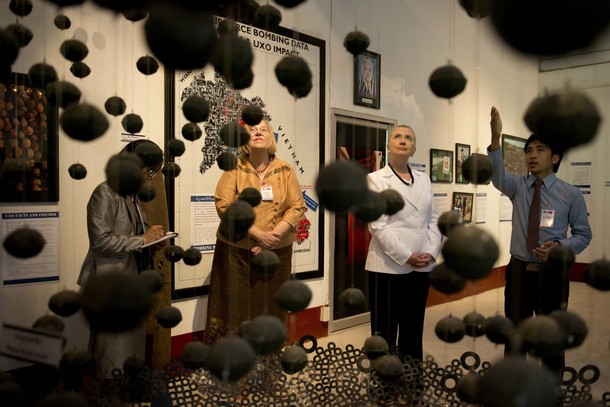
Laos country has a grievous past because of war; and to learn about that terrible history, travelers should come to COPE Visitor center. Between 1964 and 1973, the American army dropped more than 260 million bombs down to Laos, made it become the top country in the world that incurred the most severe consequences of war. About 30% of these bombs remain unexploded that killed and injured 20,000 people so far. Reaching COPE center, you will feature the history that the Lao underwent. The money donated here has been used to make artificial limbs for victims affected by bombs and mines.


Adventures to Vientiane:

Tuesday, September 29, 2015

Apsara - The Cambodian Traditional Dance

In Cambodia, it is easy to encounter pretty belles performing Robam Tep Apsara (Dance of the Apsara Divinities) at ancient temples and magnificent palaces or beside rivers.

Apsara-dance-1

Apsaras were fairies of cloud and water present in Cambodian folk tales, Hindu and Buddhist mythology. When they frolicked, sang and danced, vegetation and animals multiplied. Therefore, Cambodian people honored Apsaras as Prosperous Goddesses. The most beautiful farriers were Uvasi, Menaka, Ramba and Tilotama, who frequently appeared in Khmer works of poems, music and paintings. The fairies were also the owners of palaces (as they were wives of the Gandharvas, a heaven beings) and specialized in singing and dancing to serve Gods in victory feasts against ghosts and devils. There would be 26 fairies singing and dancing together on every banquet.

Relying on dancing movements of the fairies, Cambodian people created the fairy dance – Robam Tep Apsara to perform on festivals that extolled merits of Gods, Goddesses and Royalty. The dance, which has existed for many years, became the imperial dance. Then now it is into the familiar dance of belles on festivals, gauds and weddings.

Apsara-dance-2 
Apsara is a classical dance, mild and famous for its elegance and grandeur with gentle postures and gestures. So far Apsara is the national heritage and the spirit of Cambodia. The people who had the greatest merit in conserving and developing Apsara are the Queen Sisowath Kossamak and Princess Norodom Buppha Devi. In the 1940s, Queen Sisowath Kossamak re-created the ancient Apsara dance by educating her first grand daughter, Princess Norodom Bopha Devi, to become an Apsara dancer. Since 8 years old, the prince carried out Apsara dance in the Royal Palace. Later, she brought this fairy dance over the frontier and introduce it to the entire world.

Born in at least 2,000 years ago, the first images of the dance have still been seen on many decorative embossments, citadels and moats over hundreds of meters long in Cambodian ancient temples such as Complex of Angkor as well as many other religious constructions throughout the country.
  
Postures and curves of the dancer’s arm and body as well as the dancing costume made of gold, silver, jewels, pearls with designs of flowers and leaves were originated from pictures in the old temples, which depicted Indian epic poetry Ramayana or the fight of scrambling for the holy water vase between Demons and Gods that the dance about it includes 100 appealing and meaningful gestures.
 
Apsara-dance-Cambodia-3
Photo by Anders Jiras
By the dance, Cambodian residents wanted to voice their wishes about a peaceful, thriving life, praised the beauty of nature, country, deities and contribution of the ancestors. Besides, the dance also reflects stories about birth, aging, sickness and death - the four periods every person has to overcome - so as that next generations can understand thoroughly, experience in observing and preserving great cultural and mental values of the nation.

Annually, thanks to the patronage of the royalty, the Apsara artists can go on tour everywhere. In order to maintaining and enhancing this traditional dance, steadily there are art groups coming to schools to select small girls for educating, especially orphaned and poor ones. Girls at the age of 8 to 9 years will learn to dance and practice at school and the palace. They drills numerous attractive postures, particularly dancing acts with extraordinarily flexible hands that fingers can bow behind very close to wrist, legs can kick highly and knees can bend behind to the back. In every afternoon, the girls again sing, dance and frolic at temples in front of Apsara embossments, appealing to many travelers to admire.
 
Apsara-dance-4

Today, apart from dancers serving Royalty, there are 300 dancers performing in hotels, restaurants and Chaktomuk Theatre near the Imperial Palace in pulsating melodies with brilliant and graceful costumes.


Monday, September 7, 2015

The Land of Free Storks and Little Cormorants

Some motorboats get deeply into the forest that makes flocks of birds perching on tree branches clap wings then soar on high, creating a lively picture in Tram Chim national park, Dong Thap province, southern Vietnam.
Tram Chim national park 1

Tram Chim national park, the first Ramsar area in Mekong delta has an area of 7,000 ha, keeping an important role in the map of the world’s biological diversity. When Mekong delta is in flood season, flocks of birds in turns immigrate. 

There remains some still stay to spy out and seek out food grounds, resting places and good habitat to call their flock back. In spring, flocks of birds will return here to reside and search for food.

Tram Chim national park 2

When motorboats move deeply into the cajuput jungle, birds hearing sound in a passive way immediately soar on high.

With the aim of sustainable tourism development, the administration of Dong Thap province, Management Board of Tram Chim national park, World Wide Fund and Coca-Cola Vietnam company coordinated and deployed the project “Preserving biological diversity & developing ecological tourism based on community” in Tram Chim with total investment budget of nearly 1.2 million USD.

The project helps to protect rare birds, improve the management of hydrology and water lever adjustment, nourish aqua species and recover vegetation.

Tram Chim national park 3

Birds perching on branches of tree are really equanimous. If sitting on boat drifting slowly, it is easy to see nests of birds built all over places. According to statistics of WWF, surrounding the Tram Chim area there are about 12,000 Asian openbill storks, over 10,000 oriental darters, above 1,500 little cormorants and 6,000 little egrets inhabiting and reproducing.

Tram Chim national park 4

Tram Chim national park of Dong Thap province is anticipated that it will become a special attraction in the flood season. In 2014, there is about 60,000 tourists traveling to Tram Chim, increasing 4 times compared to the number of 2013. Above 200 households living around Tram Chim are also permitted to exploit and use the resources in a reasonable way in the flood season. This will grow averagely by 1,460,000 VND per month in income of each household.

Tram Chim national park 5

It is predicted that the Dong Thap tourism festival will take place from 25th to 27th September in the national park with the theme: “Tram Chim in flood season”.

Tram Chim national park 6

“The project “Preserving biological diversity, developing ecological tourism based on community” has implemented smoothly and acquired results as expectation. Hoping that the management and conservation of Tram Chim continue to be maintained in order to keep firmly the appellation “Ramsar” and become an experience or a lesson for other wetlands in Mekong Delta.” said Mr. Hoang Quoc Viet, the coordinator of the project by WWF.

Tram Chim national park 7

About the reason of choosing Tram Chim national park to preserve and invest, Mr. Nguyen Khoa My, the Director of Communications and External Relations of Coca-Cola Vietnam company notified: “In Vietnam, there are a lot of national parks, but this area has influenced evidently by climate change because it is located right in the basin of Mekong river. Therefore, pursuing this project will help to save ecological environment, giving back the best natural status quo for the residents and rare animals so as that they can return to reside.

Tuesday, August 18, 2015

Paradise Island Koh Rong Under Camera Lens Of A Traveler

Koh Rong is renowned as one of paradise islands in Cambodia having retained the pristine feature with rainforests and glorious beaches.

Koh-Rong-island-1
With an area of 78 km2, Koh Rong is the second largest island in Cambodia kingdom, located in Thailand bay. Most travelers reach here are foreigners. 

Koh-Rong-island-2
Many travelers getting to here cannot avoid surprise to beauty of the island. White sandy coasts stretch and surround clear, blue sea, which will bring you a relaxing, comfortable feeling.

Koh-Rong-island-3
Romantic beaches are roused by activities like fishing, surfing and rowing. You can select an active activities to explore the island.

Koh-Rong-island-4
The number of resorts is not many but it is still enough to meet demand of travelers.

Koh-Rong-island-5
Along coasts of the island, you will find a mass of big canvas beds arranged neatly, which are free for travelers to rest. Therefore, you can enjoy agreeable moments as putting down your back here. Besides, let spend a little time to enjoy delicious, fresh sea food from vendors along beaches. In this way, you not only know typical flavours of this island but also obtain chances to discover Cambodian cuisine.

Koh-Rong-island-6
For any inquiry need to be cleared up, let contact to the information section for travelers in a house adjoining to the coast. 

Koh-Rong-island-7
Koh Rong makes a strong impression on travelers not only because of its fresh, windy sea and sky, but also thanks to enthusiasm and hospitality of locals.

Koh-Rong-island-8
Koh Rong island is an interesting, alluring destination with poetic, tranquil beauty. This place is really relevant to travelers to enjoy pure, silent atmosphere and escape from bustling life. 


Before starting this journey, you should plan, book hotel and means of transport two weeks in advance. 3 days and 2 nights are enough for you to reveal totally the island. To reach Kor Rong, firstly you have to arrive Sihanoukville. After that, you take a boat to get in the island. There are two boating options for you. One, slow boat with travel time is 2 hours. Two, canoe, which will take you 45 minutes. 

You can experience active Cambodia adventures to explore hidden parts then relaxing, enjoying an amazing holiday in this lovely island.

Photo: Lamtom

Monday, August 3, 2015

Motorcycling – Cushiest Way to Explore Southeast Asia


Southeast Asia - the land of motorbikes and scooters! Small motors nimbly, smoothly move on streets. In spite of Luang Prabang, Ho Chi Minh city or Chiang Mai, it is easy to ride a motorbike around streets and even small lanes, reveal indigenous cultural features in a peculiar way.

Having low cost and compact design, easy to control, motorbike become the most common mean of transport in Southeast Asia countries. Motorbikes appear everywhere, every corner, used by both locals and foreign travelers for transfer. 

Moving by motorbike is truly flexible and convenient to explore cities, villages, fields or coastal areas. In addition, by traveling in the way of native residents, you will obtain authentically local experiences. On two wheels, it is possible to drive to ways and corners you want, stopping at anytime and anywhere to snap unique moments or take interesting conversations with locals. One day on a motorbike threading over the most hidden parts will bring fascinating experiences during your journey. 

So, when traveling in an area in Southeast Asia, you can select a motorbike as a companion and simply go. This lists below will show you some ideas for Southeast Asia discovery on motorbike. 

Yogyakarta – Indonesia

So many travelers reach Yogyakarta only to contemplate sunrise in Borobudur – the greatest Buddhism monument in Indonesia. However, many other hidden parts in this area you may not know and desire to discover. Yogyakarta city seems to be a typical slice of Indonesia with endless rice paddies, rustic villages and meandering road systems. 

You can visit this famous Hindu temple, Prambanan, as crossing over Kaliurang town, lying on the foot of the volcano Merapi. Scenery of this place can be beyond very much your imagination. Except the traffic jam in the entrance of the town, remaining things are all smooth.

Yogyakarta motorcycling

Luang Prabang – Laos

Do you want to ride around appealing streets in this ancient city? Just simple, walk to a motorbike rental shop, take one and ride. Luang Prabang is a peaceful city with lovely 2-story blocks of dwellings, quaint small houses, colorful tuk tuks and long queues of monks walking moderately on bare foot to beg for alms in the quite atmosphere. Perhaps you will be excited as encountering an old temple quite Chinese in style. Bring along a map if it is necessary for you.

Getting out of this safe and sound city toward surrounding areas, more challenges are waiting travelers to conquer. You can head to Kuang Si and Tad Sae, two superb, emerald waterfalls. The roads are relatively convenient. Passing over jungles, many beautiful landscapes will disclose.  

Luang Prabang motorcycling

Ho Chi Minh city - Vietnam 

Traffic in Vietnam always make a deep impression on any oversea traveler first time stepping on this country. Amazing. Incredible. Thousands of motors moving smoothly in narrow space among disorderly whistling noise; and patience of residents in traffic jam are unforgettable images. 

You can take a Saigon Vespa tour to get around the city. Classic but graceful Vespa scooters will take travelers to discover incredible street food, to original bars, restaurants and lovely hidden streets. This is a great way that helps you find less well-known places and enjoy real local cuisine. If you are impossible to ride, you can sit in the rear position and comfortably sightsee streets. 

Saigon Vespa tour

Chiang Mai, Thailand

Chiang Mai is located in a highland of Thailand so this city has a natural beauty actually mind-blowing. The region is dominated by forests, strawberry fields, rivers, streams and many other ecological sites.

You can trek 14.5 km to reach the mountain top and visit the sacred Wat Phra That temple – one of the most renowned spots in the city. However, paying attention that you can encounter the traffic congestion, especially at the end of the day.

Or, you can liberate and ride motorbike to visit historic places in the central Chiang Mai city. Let reach Buddhism pagodas built since the city newly established (about 700 years ago). If it is hot, you can take some breaks, rest, enjoy the “pad Thai” dish then continue your journey.

Motorcycling Chiang Mai
 Photo: Peanuts or Pretzels

Sumatra, Indonesia

If having scanty time, you can get to Maninjau – the lake formed from the crater of the former volcano in Sumata, Indonesia. Around the lake is small fishing villages, rice fields, schools and mosques. Here, you are never stuck in traffic. 

Koh Lanta, Thailand 

Koh Lanta is an island district in Thailand. Not famous like Koh Phi Phi or Phuket, but it is an ideal destination for excursions by scooters or motorbikes. On the island, though the way is just only 26 km long, you still can have a lot of awesome experiences: local life, fabulous scenery and traffic. 

Almost the streets have pavements, safe and not crowded. Spend all your day to contemplate the stunning beach like paradise or visit the old quarter, where retains memories of the island. You can admire traditional houses lying near the sea, nice café and peaceful space. 

motorcycling Koh Lanta