Thursday, November 26, 2009

Riding Motorcycle on the Ho Chi Minh Trail, Vietnam

An eleven-person, a 18-day trip with 11 -day motorcycle trip through Vietnam during the hottest part of the year may sound like an endurance test to some, but for John Kerry, vice president of Motorcycle Travel Club in USA. It’s a vacation.
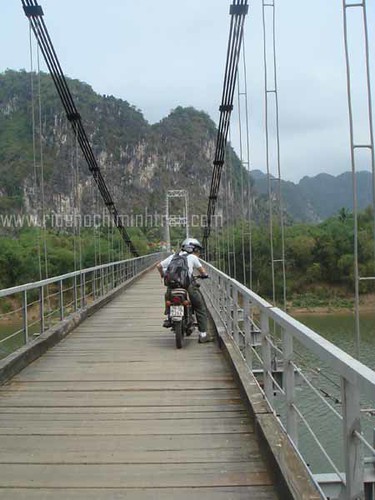

Motorcycle trip on Ho Chi Minh Trail, Vietnam

From August 30 to September 17, Kerry, two guides and nine others will make the 800-mile journey from Hanoi to Hoi An riding small motorcycles down the country's eastern coast. A combination of off-road and highway riding, their route will take them to sites such as the Phong Nha Cave, widely hailed as the most beautiful in the region; Hue, the imperial capital of feudal Vietnam; and China Beach, the site of the first major Marine landing of the Vietnam War.

Active Travel Asia, a professional adventure company that offers bicycle and motorcycle tours throughout the country, is arranging the trip. Kerry's group paid $1,954 per person, but prices vary depending on the size of the group and the route.

The company provides most of the essentials: motorcycles, fuel, escorted van, camping equipment, food and guides. Tourists need only supply their own clothing and transportation to and from Hanoi. But Kerry, an Adventure Travel Editors, is preparing for the trip in other ways.
"I'm taking motorcycle tour here and I’m eager to travel to Vietnam war in the past," Kerry, 65, says, adding in an e-mail: "I'm happy to challenge this historial trail on a motorcycle after more than 30 years, and handling the rougher parts of the Ho Chi Minh Trail [the route that the North Vietnamese used to travel to South Vietnam during the war]. I'm told some of it is no more than a cow path." Though Active Travel Asia's Web site (www.activetravelvietnam.com) warns of the "no rule" nature of Vietnamese streets in several alarming sections, it also promises that the company takes tourists on the safest roads. Despite those reassurances, Kerry is taking few chances. He requested that the tour begin outside Hanoi, though it usually starts within city limits.

"I was not going to drive in that crowded traffic, probably the bad traffic in Vietnam," says Kerry, who plans to write about his experiences for your daily newspapers. "I do know Hanoi has one of the highest fatality rates in the world."

Though cool on the prospect of motoring through Hanoi, Kerry does plan on spending several days in the capital before his tour begins. "I'll visit the site where John McCain was held prisoner for 5 1/2 years, known to American POWs held there as the Hanoi Hilton," he says. "I'll also revisit Ho Chi Minh's mausoleum in Hanoi's Ba Dinh Square. I'm curious if the Vietnamese still line up to file past his open coffin to view his preserved corpse... And, of course, [I'll see] the French architecture, which dominates the Old Quarter of the city."

As excited as he is about the visceral thrills of the motorcycle trek, the chance to immerse himself in Vietnam's history is even more enticing. "As a young reporter the war was going on and I covered a lot of campus demonstrations working for MTC," he says. "Having traveled there in the spring of 1993, I got even more interested in it. Hanoi was just coming alive then. Southern Vietnam was obviously much more developed than the North so I'm looking forward to seeing it now, almost 17 years later."

By Bobby Nguyen

Recommendation about motorcycling tours in Vietnam:
- Motorcycle Travel Guide in Vietnam
- Ride Ho Chi Minh Trail tours
- Motorbike Tours in Vietnam

Wednesday, November 25, 2009

Buffalo tours of pottery town, Vietnam

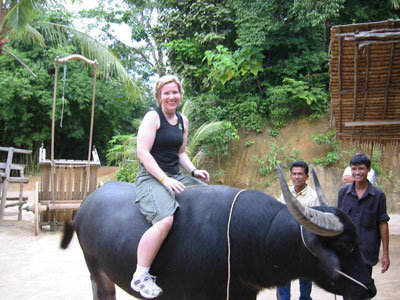
Among the tourist sites surrounding Hanoi, the Bat Trang pottery village with 500 or more years of history, is an ideal place to visit, attracting a large number of people from the city – and foreign tourists. Slow and steady: Japanese visitors enjoy a buffalo cart tour around the pottery village.

Buffalo tours in Vietnam

Just 14km from central Hanoi, the village is easily reached by motorbike – the most popular transport means in Vietnam.

If you’re too lazy to drive yourself or are not game to sit on the back of a xe om or hired motorbike, you can catch a bus at Long Bien Bus Station.

This way takes three times as long, but it’s so cheap! Tickets only cost VND3,000 – about US$0.10. The bus will take you to the village pottery market, where more than 100 stalls present tens of thousands of ceramic and pottery products.

The items include fine celadon from an ancient tradition and other great examples of ceramic arts and crafts. The high quality porcelain is decorated with dragons and phoenix, flowers and images of people and landscapes, all reflecting daily and spiritual activities in Vietnam.

Visitors can spend several hours just browsing among the endless little shops, each with different wares produced in a different family kiln.

According to the head of the market management board, Tran Quoc Viet, the market welcomes a large number of visitors every weekend.

A group of middle-age women look happy with heavy sedge bags containing pottery products they bought in the market.

"Although my family has every household product, sometimes I and other neighbours call each other and go to the village. It’s the way we unwind," a woman cheerfully said.

For these women, beautiful ceramic objects, mostly at surprisingly affordable prices, are the main attraction. "I’ve bought a charming vase with the lotus motifs for just VND20,000," another woman said.

Thuy Linh, a grade-10 student, said she sometimes went to Bat Trang with a group of her friends. "Unlike other people who usually buy ceramic household products, we only pick up cute stationary or ceramic jewellery," she said.

"I’ve just bought a black-and-white Japanese Monokuro Boo pig, plus a keyholder with the ceramic initial ‘L’, the first character of my name, carved on it. My friend bought a wind chime and a cute piggy bank," she said.

There’s more than just searching among the stalls, tourists can also experience pottery artists a work – on the spinning wheel, painting objects when they dry or loading up the kilns.

Visitors can also make their own cups, dish, bowl, vase or animal – and they will receive the finished, fired product within a few days. Many villagers offer this service for VND10,000 to 30,000, depending on the size of product. "I relived my childhood when fiddling with a piece of clay," said Tuan Nam, a first-year student.

Recently, a new and relaxing way to see Bat Trang has been offered. A buffalo cart takes tourists around the village.

According to Nguyen Minh Hai, director of the Minh Hai Ceramic Company, who offers this first-ever service in the village, most who tour the village this way felt relaxed and interested because they could view the scenery at their leisure.

"The idea of using a buffalo cart to carry tourists was initiated when I went to Japan looking for business opportunities for our products. I realised the buffalo was easily recognised as a symbol of Vietnam – a rice producing country. So why not use farm animals to transport tourists around the village?" he said.

Before starting their cart journey, tourists are shown the way ceramic products are made in a workshop. Teams of young men and women work on production lines, baking, sanding and painting.

A journey around the village, a distance of about 2km, takes an hour. The price ranges from VND50,000 to 100,000 depending on the duration of the tour and how many stops are made. There are two buffalo carts working in the village, providing tours for about 100 visitors a day.

Like other villages in the north, the village hold its main festival in the second lunar month. This year, this fell in March. During the three-day festival, many traditional activities were held in and around the village temple, situated close to the steep banks of the majestic Hong (Red) River.

Among the various ritual activities held during the festival, the most important is a boat procession by village elders and monks to the centre of the river to collect the purest flowing water.

Before they set out, the boats made offerings to ask the Water Genie for permission to take the water.

The water was then scooped from the river by two prestigious elders, brought to shore and then paraded around the village before being taken to the communal temple.

Source: Viet Nam News

Related sites:
City Guides in Vietnam
Hanoi tours

Monday, November 23, 2009

Dalat from a different perspective

Dalat, the city of flowers, is not strange to tourists with its famous sightseeing spots such as Lang Biang Mountain, Xuan Huong Lake and Than Tho Lake. If this is your first time to this romantic land, you are advised to visit the places just mentioned which have become legends of Dalat. But for those who have been to Dalat many times, you are advised to visit places that will bring you a different Dalat.

Seasoned tourists can augment their itineraries with completely new destinations. Dalat flowers are well-known for their beauty. The local flower farm is one of the ideal destinations for those who prefer a trip towards nature.

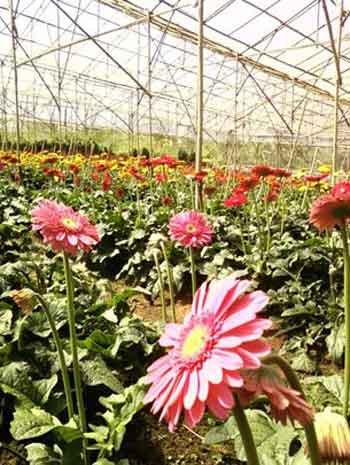
a greenhouse growing colorful flowers in Dalat city, Vietnam

A greenhouse growing colorful flowers in Dalat city, Vietnam

Visiting the greenhouse is an opportunity to admire at close range Dalat roses and gerberas. Standing in front of the glass with a furrow of flowers stretching on and on is an amazing feeling. The weather is cool, even under the noon day sun, while the flowers are full of colors that compliment each other.

Veteran tourists should visit the coffee farm to learn how coffee beans, such as Robusta and Abrabica, are grown in Vietnam. Those interested in new kinds of business should visit the cricket farm to learn how crickets are raised and what they taste like.

Those who prefer to learn about ethnic minorities should not miss Lat Village where the indigenous K`ho Lat live in Dalat. Guests will have a chance to know about the customs and habits of the people here.

The silk weaving factory is also an interesting place to visit. Coming here, tourists can capture the process of releasing silk, making follicles from silkworms, spinning and weaving. Before coming back to Dalat, tourists should visit Elephant Waterfall. This is one of the most beautiful waterfalls in the Central Highlands at a height of 25 meters. With a powerful flow, the bouncing white foam is a spectacular sight.

The highlight of the tour to Dalat is that instead of moving by car, tourists ride motorcycles. You will find it hard to drive yourself on the winding slopes of Dalat at first, but then an interesting feeling of exploring the land overwhelms each tourist. There are few tour operators organizing motorcycle tours to Dalat.

Source: SGP

Recommendation in Dalat, Vietnam:
- Dalat tours and short excursions
- Bike Dalat

Friday, November 20, 2009

Conical hats draw many visitors in Vietnam

Visitors to Phu Cam village in the former imperial capital of Hue will be instantly impressed by its traditional way of making conical hats. Poem-hat is a distinctive feature of culture in Hue. Locals say they like to do the job not only to earn money but to preserve their age-old tradition.

Hat-making village Phu Cam (also Phuoc Vinh) lies on the southern bank of the An Cuu River in the centre of the former imperial capital of Hue. It’s a village famous for its traditional way of making conical hats for hundreds of years.

Making conical hats in Vietnam

Phu Cam-made hats look graceful, soft and thin as silk. Hue landscapes or even poems can be seen clearly through the hats in the sunshine. It takes woman much time to make the frame and iron leaves before young girls start sewing. The beauty and grace of a hat depend much on the frame (made of 16 brims from the hem to the top). Artisans use sharp knives to prepare the brims and make the frame that needs skills, techniques and experiences, as well as mathematical calculations which have been handed down for generations.

Leaves to make hat play a vital part, leaves have to be blue-white, neither too young nor too old. Collected leaves are to be put to dry in the sun, then put to be moistened by dewdrops, then to be ironed flat on a steel- plank above a kiln, cleaned with a towel. After all this, leaves are cut to fit the frame.

How to arrange the leaves on to the frame is not easy. Each hat needs 50 leaves and between the leaves are coloured papers with pictures or paintings of landscapes, or even poems. Hat-makers are hardworking and careful and diligent. Hats are served with silk-threads and the chin-straps are made of coloured silk (black, white, yellowish, purple, violet…) to harmonize with Hue climate and beauty.

Poem-hat is a distinctive feature of culture in Hue. Locals say they like to do the job not only to earn money but to preserve their age-old tradition as poem-hats have been absorbed into folk music and songs. Today hat are still used by young girls to shade their heads in the sun and to make them look more graceful in the traditional Ao Dai (long dress).

Recommendation in Vietnam:
Travel Guide in Vietnam
Short excursions in Vietnam

Monday, November 16, 2009

Buying a touring motorbike in Vietnam - Vietnam Motorcycling Travel Guide

By far, the best way to experience Vietnam is by motorbike. As with elsewhere in southeast Asia, here, the motorbike is king. They are cheap to buy, easy to repair, and they can take you places the tour bus would never dare to go. What's more, there are no restrictions on foreigners buying motorbikes. All you need is a passport and valid visa, and you'll receive a title of ownership and a deed of transfer. Rentals will suffice for most, but if you plan on serious bike time, buying is more economical -- you can even sell the bike before you leave and recoup most of the expense.

We know the traffic seems crazy. But once you get the hang of it, you'll learn there is a method to the madness. Travel by motorbike has its dangers, to be sure, and should be undertaken conscientiously. But the vast majority of foreigners come away from their motorbike trek with nothing but great experiences to talk about back home (and maybe a few tail-pipe burns to remember them by).


Vietnam Motorcycling Travel Guide

You can buy a bike almost anywhere, but bigger cities will have a better selection and be more comfortable selling to foreigners. Naturally, it's best to shop around. When you settle on a bike, insist on taking it for a spin -- and to a mechanic for a once over.

Your two main considerations are whether to buy new or used, and how powerful a bike you need. New Japanese and Chinese models can be purchased for as little as US$400. They should be more reliable, but then again, you may be the one stuck working out all the kinks. And you'll take a bath on the resale value.

We recommend a used bike. This may seem a bit daunting, and it's a good idea to make friends with a trustworthy mechanic if you can swing it. When you buy a bike, all you're really looking at is the engine, the shocks, the wheels, and the frame. If nothing's leaking or broken, and it kicks up a throaty hum when it runs, you're off to a good start. Everything else on a bike can be fixed cheaply and easily -- though be sure to factor such repairs into the price you plan to pay.

In terms of power, a 100 cc bike is fine throughout most of the country, depending on the weight you intend to carry. By the time you stack two people and two full packs on it, you'll struggle up the hills even in Da Lat. Northern Vietnam is notoriously hilly and requires at least a 115 cc bike. Check out the bikes used by the guys who do the Easy Rider tours, and look for something similar. If you've never driven a clutch, consider learning -- it quickly becomes second nature.

Even if you buy a bike that's been restored, be sure to take it to a mechanic anyway and put some more money into it. New tires, break drums, batteries, starters and the like are all cheap and will give you that much more peace of mind. Finally, think about where you're going to put your stuff. We got a custom-made back-rack for US$6.25.

When it comes to plotting a route, we suggest planning to see more of the country by seeing less of it. You can't see everything from Sapa to Vung Tau by motorbike in a month. Pick a region -— north, central, or south, and focus on that. Alternately, many buses and trains will take on a motorbike as freight for the price of an extra ticket, so you can split a trip between two regions. Don't plan an overly-aggressive route. The whole point is to take in the scenery, to stop and explore along the way. We find more than 120 kilometres in any given day starts to feel rushed. Fortunately, in thin, compact Vietnam, there is always a good option for your next stop within that distance.

It's also worth mention that, while the 'open road' in Vietnam can be breathtakingly beautiful and provide an utterly authentic experience of the country, this is Vietnam, and not all roads are open. Ask around if you plan to go into remote regions of the country, especially near the borders, but there's really no harm in just trying your luck. The worst that can happen is that the police will ask you to turn around.

Final note: wear a helmet, bring rain gear, and memorize the lyrics to Born to be Wild before you leave. You'll be needing them.

Source: Travelfish.org

Related sites:
Motorcycle Vietnam

Ride Hochiminh Trail

Motorcycling Tours